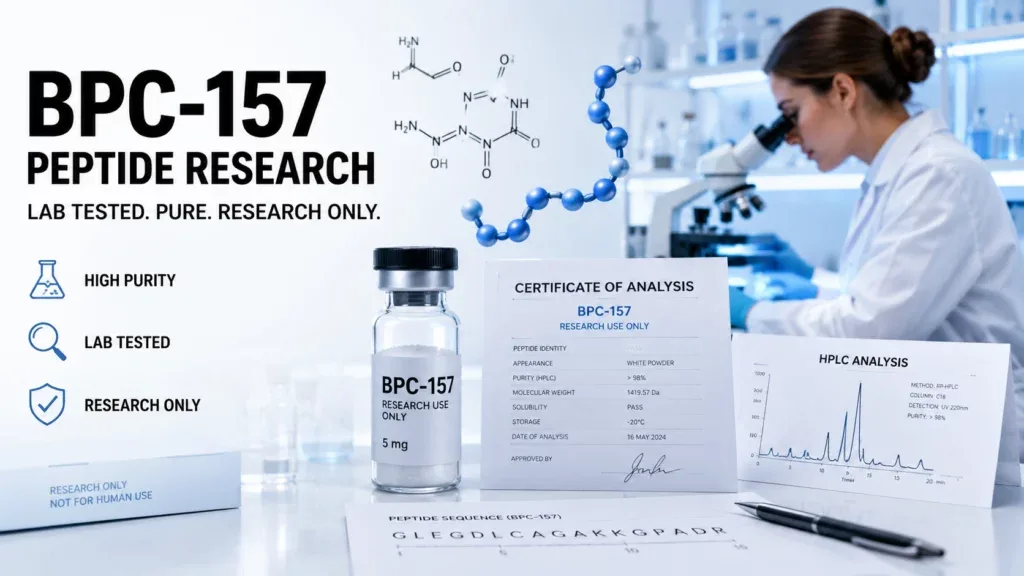
BPC-157 research has gained attention because this synthetic peptide is often discussed in studies related to gastrointestinal models, tissue modelling, angiogenesis pathways, and broader preclinical research. However, it is important to keep the topic clear: BPC-157 is not approved for human use, and this article is for research and educational purposes only.
For laboratory sourcing, Polygon Peptides offers BPC-157 10mg research-grade peptide supplied as a lyophilised research product.
What Is BPC-157?
BPC-157 stands for Body Protection Compound 157. It is a synthetic pentadecapeptide, which means it is made from 15 amino acids.
In research literature, BPC-157 is often described as a stable gastric pentadecapeptide. It has been studied mainly in preclinical models, including laboratory studies related to gastrointestinal protection, tissue response, angiogenesis signalling, and inflammatory pathways.
The key point is simple: BPC-157 is a research compound, not a licensed medicine. Therefore, any discussion around it should focus on laboratory research, compound quality, storage, documentation, and scientific context.
Why Is BPC-157 Studied in Research?
Researchers have shown interest in BPC-157 because it appears in several experimental models connected to tissue response and biological signalling.
Some published research discusses BPC-157 in relation to:
- Gastrointestinal research models
- Angiogenesis-related pathways
- Tendon and tissue modelling studies
- Brain-gut axis research
- Experimental wound-healing models
- Inflammatory response models
For example, this PubMed-indexed review discusses BPC-157 in relation to brain-gut and gut-brain axis research: Stable Gastric Pentadecapeptide BPC 157 May Recover Brain-Gut Axis Function.
Another open-access review looks at BPC-157 and wound-healing-related research models: Stable Gastric Pentadecapeptide BPC 157 and Wound Healing.
However, most available work remains preclinical. As a result, researchers should avoid treating animal or cell-model findings as confirmed human outcomes.
BPC-157 Research and Mechanism Interest
The scientific interest in BPC-157 comes from how it appears to interact with several biological systems in experimental settings.
Research papers have explored links with:
- Nitric oxide signalling
- Blood vessel formation pathways
- Collagen and tissue response markers
- Gastrointestinal barrier models
- Inflammatory pathway modulation
- Cell survival and migration models
This does not mean BPC-157 should be promoted for personal use. Instead, it means the compound remains a subject of ongoing laboratory interest.
A recent review also highlights both the research interest and the safety uncertainties around BPC-157: Regeneration or Risk? A Narrative Review of BPC-157.
That balanced view matters. A good research overview should not only mention potential mechanisms. It should also explain the limits of current evidence.
What Researchers Should Know Before Studying BPC-157
Before including BPC-157 in a research workflow, researchers should check the quality, documentation, and handling standards of the compound.
Important checks include:
- Is the peptide supplied for research use only?
- Is there batch testing information?
- Is purity clearly stated?
- Is a Certificate of Analysis available?
- Is the product lyophilised?
- Are storage and handling instructions clear?
- Is the supplier transparent about compliance?
These checks help reduce uncertainty before the compound enters a protocol.
For UK-based laboratory buyers, the BPC-157 10mg vial from Polygon Peptides is listed as a research-grade product. The page also states that it is supplied as lyophilised powder at high purity for research use.
BPC-157 and Product Quality
Product quality matters because peptide research depends on consistency.
If purity, identity, or storage conditions are unclear, results become harder to interpret. A study may look like it is testing the compound, but poor sourcing can introduce extra variables.
That is why HPLC testing, Certificates of Analysis, and proper storage guidance are important. They help researchers understand what they are working with before designing a study.
For general peptide handling knowledge, Bachem provides a useful reference on peptide care and storage: Care and Handling of Peptides.
GenScript also provides helpful peptide storage and handling guidance: Peptide Storage and Handling.
BPC-157 Compliance and Safety Context
BPC-157 is often discussed online in ways that go beyond the evidence. That is risky from both a scientific and compliance point of view.
The World Anti-Doping Agency lists BPC-157 under prohibited substances. USADA also notes that BPC-157 is an experimental peptide and has not been extensively studied in humans. You can read their athlete-focused warning here: USADA BPC-157 peptide notice.
For Polygon Peptides, the safest and most accurate position is clear:
BPC-157 should be discussed only as a research-grade peptide for laboratory use. It should not be presented as a treatment, supplement, recovery product, or human-use compound.
How BPC-157 Fits Into Research Planning
If BPC-157 is included in a research protocol, the study design should define the research question first.
Useful planning questions include:
- What model is being studied?
- What endpoint will be measured?
- What comparison group is needed?
- What storage conditions will be used?
- How will batch information be recorded?
- How will purity and identity be verified?
- What documentation will be kept?
This kind of planning helps keep the research process clean and repeatable.
It also reduces the chance of unclear results. When the compound, batch, storage, and observation points are documented, later interpretation becomes easier.
Final Thoughts on BPC-157 Research
BPC-157 is a synthetic research peptide with a large amount of preclinical interest. It is often studied in models connected to gastrointestinal function, tissue response, angiogenesis pathways, and broader biological signalling.
However, the evidence should be discussed carefully. Most research is not the same as confirmed human clinical use. Therefore, the best way to approach BPC-157 is through a research-only lens.
For laboratory sourcing, view the BPC-157 10mg research-grade peptide from Polygon Peptides.