Introduction
The best research peptides uk can never be a blind buy. Suppliers can affect confidence in the products, record keeping, and future research in scientific research. A reputable peptide supplier will provide you with more than a clean website. It should offer documentation, quality testing, clear labelling, responsible wording and a buying process that feels organised from the first click to the last delivery.
To meet the needs of many users for speedy access to research materials, they look to buy research peptides uk. But with speed–that’s only helpful when a proof comes with it. Even if the supplier guarantees quick delivery, the product may not come with a clear identity and batch information, leaving the customer with even more hesitation than certainty about the product. A good buying decision begins with trusting signals prior to checkout.
This guide will help you identify peptide suppliers who take research-grade standards seriously to create a practical trust checklist. It’s for the readers who want clarity and not confusion, and signals and not empty claims.
The importance of trust before using any lab purchase.
The first type of research source is trust. Before the study, storage, or documentation of a peptide, the buyer must have confidence in the product because it is what the supplier claims it is. If they don’t have confidence, the later steps are not as strong.
For the research labs uk peptides, trust is not a soft notion. It is a component of the research process. Labs might want to compare batches, repeat studies, or check records at a later time. In a situation where insufficient data is supplied from a supplier, the laboratory may have difficulty in determining what was used.
Verifying is easier when it is a trusted supplier. It provides information on the product, batch information, testing documentation, and unambiguous research-only terms. The information assists researchers in maintaining control of their workflow.
Pass the First Trust Test with Best Research Peptides UK.
Be sure the best research peptides uk pass the initial trust test before a buyer reaches out to support. Product pages should be clear, specific, and helpful. If someone uses the term “premium quality” in a generic way, this isn’t a serious supplier.
A well-written product page will have details on compound identity, purity, storage guidelines, number of vials, and batch information. If the product page is inadequately filled or appears to be overly sales-driven, then it should ring an alarm bell.
A reliable supplier won’t have to be followed by researchers for the details of their basic research. It communicates information that is open to buyers to make a careful decision.
The first trust test is easy: is the supplier providing evidence or making promises?
Confirm the Product Identity.
You should be able to easily identify a research-grade peptide. Product identity is the basis of trust, as researchers need to be sure what compound they are reading about.
Peptides uk in the specialist search, like genetic research, especially becomes important in regard to identity. A supplier should give information about the product, sequence if applicable, molecular weight, formula, appearance, and storage conditions.
If there is just a name and price, the buyer is not in a position to make an informed decision. That sort of listing might be handy, but it isn’t research-friendly.
Identity verification is easy with trusted suppliers. They don’t make simple product checking into a puzzle.
 Check the Online Buying Experience
While online ordering is helpful, it shouldn’t be reckless. However, a smooth checkout is only advantageous if the supplier supplies adequate information in advance of payment.
Research peptides online uk shopping users tend to compare several websites quickly. It is best to take your time and see if the site has clear terms and conditions, COAs, research-only language, and realistic product descriptions.
A reputable online supplier ought to make the purchasing process appear to be managed. It should present what it’s buying, the product’s positioning, and the supporting documentation.
Speed ordering is not the end goal. The aim is to become confident at ordering.
Examine the claims for purity carefully.
One of the most sought-after quality claims when sourcing peptides is purity. It is also one of the most easily confused claims.
Buyers should not consider purity percentage as the sole criterion when looking at peptide research chemicals for sale. A number is no good without testing and batch-level documentation.
Any purity claims should be explained or provided with evidence by a trusted supplier. The Certificate of Analysis should be a representation of the batch of product and contain relevant test details.
If you don’t have proof of high purity, then it’s just a polished sentence. The document that backs up the claim is more important than the claim in research.
Apply a separator to keep Research Peptides away from Skincare Peptides.
They can be used in skin care and can be confusing to readers who are not familiar with peptides. There are cosmetic peptides and research peptides.
A question such as what moisturizer contains the most peptides is a finished batch of skin care products, not actual research-grade products. A moisturiser is a substance that is intended for topical use by consumers, whereas a research peptide is intended only for controlled laboratory research.
A good supplier shouldn’t merge these categories. It should not make sales statements like in skincare and should limit the use of product terms to research use.
Separation establishes trust as the supplier recognizes the difference between cosmetics for consumers and laboratory materials.
Know the meaning of Skin Peptide Terms.
In terms of the phrase, types of peptides for skin are typically a cosmetic ingredient. The signal peptides, carrier peptides, and other peptides that are used in formulations may be included in common skin care conversations.
Such information may be relevant for skin care readers but shouldn’t be taken to imply that raw research peptides are appropriate for individual use. Research products are not cosmetic products.
The difference should be explained by a trusted content page. It can communicate about the peptide terms while maintaining the research materials within the proper scientific context.
Good information isn’t mixed to drive in traffic.
Don’t rely on a catalogue that doesn’t have details.
While having a lot of products available in a catalogue can be impressive, it’s not the same as quality. There are many items that can be listed by a supplier without providing good information.
Users searching for peptide compounds for sale may end up on generic pages that list peptide compounds. What matters is if there is something that is specific to each product, and not just a text that you see over and over again.
A good supplier cares for each of the compounds. It should contain product-specific information, storage notes, details about the documentation, and positioning for research use only.
A smaller catalogue, well documented with evidence, is more trustworthy than a large catalogue of thin descriptions.
 Ensure that the product complies with the price before use.
Compliance is paramount, but price is another factor. When product categories are diverse and/or sensitive, a non-compliant supplier may present a risk to buyers.
Buying research chemicals uk can result in numerous kinds of substances. The phrase is very general; therefore, it is important to verify the product in question, its intended use, and the terms of the supplier before ordering.
If products are for laboratory research only, this should be clearly indicated by a trusted supplier. It must not be promoted for human use, medical use, veterinary use, or experimental purposes.
Compliance is more than the bottom-of-the-page legalese. It’s a sign that the supplier has an understanding of responsibilities.
In legal matters, the use of legal wording is crucial.
The language in legislation ought to be clear, yet not rash. Don’t assume that any compound is automatically safe, unrestricted, or even suitable for every buyer, or make such claims on behalf of a supplier.
The term legal research chemicals uk should not be used lightly, as the legality of the compound, its classification, and intended purposes all play a role in determining the legality of the compound. Any supplier who seems to make it easy to do everything should be avoided by the buyer.
A responsible supplier provides realistic terms and doesn’t make exaggerated promises. It shouldn’t be using the law as a ploy to make a sale!
Having a legal wording that is formally done and done well is a valuable trust signal. It displays discipline, not panic.
Online Chemical Suppliers Need Traceability
Traceability involves linking the product page, order book, batch number, COA, vial label, and delivery details. This is important for responsible sourcing of research.
Those looking for research chemicals online uk should not pay attention to availability. Buyers may need a clear record trail even if there is a product in stock.
If a study needs to be repeated, reviewed, or compared to another batch, then traceability is helpful. It also assists the researcher in arranging materials post-delivery.
The supplier may not be able to trace the product to a batch or document, and the buyer may have no trace record at all.
Check Before Purchase
However, a search for buy research chemicals uk shouldn’t stop at the initial checkout button. Please check product details before ordering.
Key checks include product identity, batch documentation, storage advice, supplier terms, and research-only statements. This information assists in filtering out strong supplies from bad ones.
Verification is effortless when it is a trusted supplier. It doesn’t obscure vital information or give the buyer a chance to rack their brains.
The most effective purchases are made prior to any issue, not after it has come up.
Even if your pages are on sale, they need to appear in a responsible manner.
Business pages don’t have to be drab. Research standards should not be sacrificed by a supplier for the sake of product availability or product details, or for providing discounts or category pages.
As you’re shopping around the web for research chemicals for sale uk, you should look to see if the site still contains responsible language and links to helpful product information. Sales jargon/salesy talk can erode trust.
The research chemical page shouldn’t be like a knock-off item on the weekend. It should sound formal, precise, and straightforward.
Supplier quality includes responsible presentation.
Take care when conducting Prescription Linked Searches. Be cautious when conducting a Prescription Linked Search.
There are search overlaps with topics for prescription medicines. This area requires special care because there should be no promotion of medicine-related compounds via research routes in this area.
The keyword tirzepatide peptide vial uk is sensitive due to the association with prescription medicine products. It is unethical to imply that online research pills are an alternative to the legal way of getting healthcare.
If they are seeking medicines, they should consult a competent health care professional and follow authorised supply routes. Research suppliers need to maintain this boundary.
Care must be taken with a supplier that mixes medicine and research jargon.
 Look at the Vial Label.
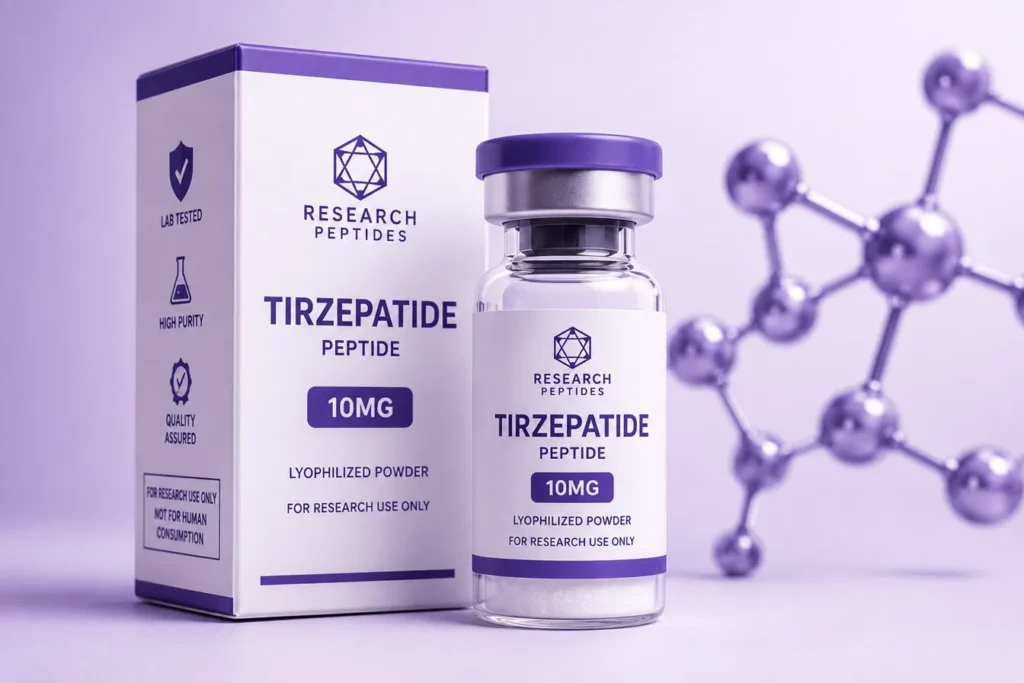
A small label that you can’t miss the job of doing has a big job. It assists in establishing the identity of the product, its batch, and storage instructions.
The term peptide vial labels uk would be a prominent part of a trust checklist, as labelling is one of the easiest quality signals that can be checked post-delivery. A good label will contain the product name, Batch or Lot number, quantity, Storage note, and research only wording.
Label must be identical to the COA and the order record. The buyer needs to contact the supplier in case the information provided by him/her is inaccurate prior to using the product.
Correct labelling means that a supplier cares about paying attention to all important details.
Ask early questions about the law.
Before purchasing, buyers must determine if this product is the correct one for the research that will be conducted. But availability is not the only issue that matters here.
There is no definite answer to the question “Are peptides legal in uk?” This is dependent on the peptide, product category, application, and source. Certain peptides may be available for legitimate research purposes, and some might need additional legal or regulatory scrutiny.
A responsible supplier should not give overhasty blanket answers. It should give clearly-defined terms and not be used in an incitement manner.
Before placing an order, a buyer is advised to consult a legal or institutional expert for advice.
Read the Supplier’s Communication Style.
Quality can be a clue to a supplier’s understanding of their products. A trustworthy supplier should be able to provide a straightforward reply regarding fundamental questions, without getting agitated.
Request COA, batch matching, shipping, storage directions, or research only. The reply should be specific to the degree that you will be able to make a decision.
When you get only general answers or when you are urged to purchase quickly, it’s not a positive indicator. Research buyers don’t need to be sold to.
Communication is one of the most trustworthy human signals.
Check Packaging & Delivery Standards.
Packaging will protect the product during shipment. It also indicates if the supplier exhibits a “beyond the sale” attitude.
A good peptide supplier should employ packaging that prevents the damage of vials and helps to maintain the product quality. For certain items, temperature control might be necessary, and the supplier needs to elaborate on their method of doing so.
After placing their order, the buyers need to check the accuracy of the order and the packaging of the product.
Good packaging is a sure sign of a supplier’s respect for the product.
Create a Trust Checklist Before Checkout
Take advantage of a simple trust checklist before purchase. Is product identity clearly communicated to the supplier? Will the COA be batch-specific? Does the label on the vial agree with the document? Is it written how to store? Does the product have a valid research-only label?
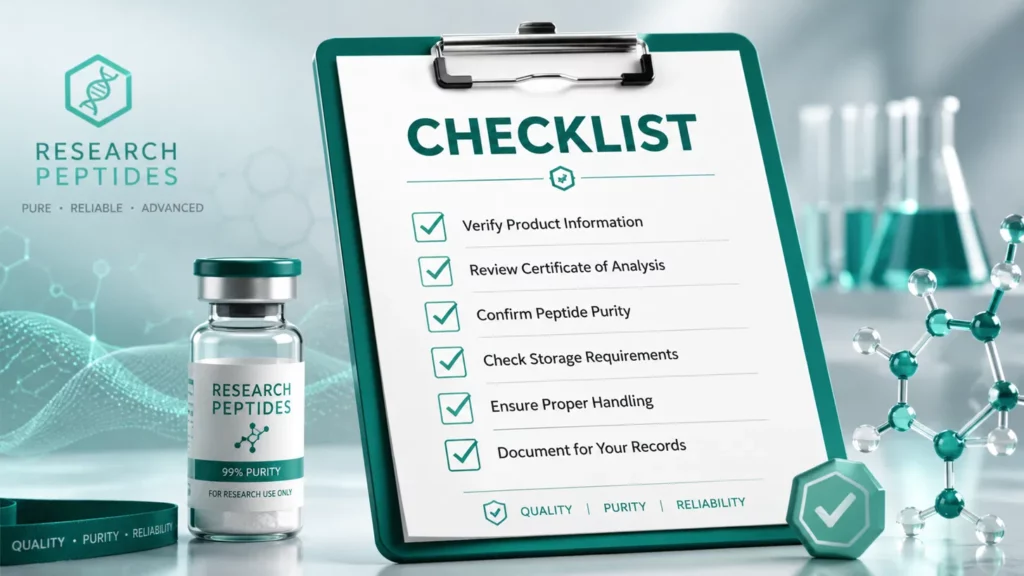
Look to see if the supplier doesn’t use medical claims, personal-use terminology, or over-appealing claims. Responsible wording is important because responsible words equal responsible selling.
A checklist helps to take emotion out of the decision. It makes the buyers focus on facts rather than prices, urgency, or design.
Trust becomes much easier when one knows what to look out for.
Concluding Remarks
With the help of a trust checklist, it’s easier to choose the best research peptides uk. Product identity, product batch COAs, vial label accuracy, language of compliance, safe packaging, and helpful support should all be provided by a reliable supplier. In the presence of such trust signals, researchers are better equipped to make better choices about their sources and to ensure the quality of their scientific research.
FAQs
1. How do I know if a peptide supplier is trustworthy?
The quality of the supplier’s COAs, product specifications, product labels, research only, packaging safety, and customer service are hallmarks of a reliable supplier. If these details are not available, it is better to take a break before making the purchase.
2. What should I check before buying research peptides online?
Verify product identity, purity documentation, batch number, storage policy, delivery policy, and research-use-only requirements. These tips can help you steer clear of suppliers whose offerings are built on marketing promises.
3. Why is a Certificate of Analysis important?
A Certificate of Analysis serves to validate the batch details, purity claim, and testing details. It provides researchers with a document to be read before picking up the material for controlled work.
4. Can research peptides be used for skincare or personal use?
No. Research peptides are intended for controlled laboratory use only. Skincare peptides in finished cosmetic products are different from raw research-grade compounds.
5. What are the biggest red flags in a peptide supplier?
The areas of major concern include the absence of COAs, labels that are not clear enough, exaggerated claims, personal-use product language, weak compliance language, insufficient technical product information, and poor support.