Introduction
For those who try to purchase tirzepatide uk by online, one may encounter purity percentages, testing badges, and Certificate of Analysis statements before anything else. However, from the point of view of a laboratory test, what should be considered is whether the report associated with the purchased sample indicates a clear name of the substance, batch number, and the way it was analyzed. Polygon Peptides supplies laboratory products strictly for use in the laboratory and in-vitro research only; information provided in this guide does not serve as a dose or a treatment recommendation.
Quick Answer:
“What should you verify in your tirzepatide report?” would be the following:
A good tirzepatide lab report sample would help a researcher to confirm the following nine points: product identity, analytical procedure, interpretation of the purity test result, batch number, testing date, laboratory information, raw chromatography data, consistency of COA field values and additional identity test data, if there is any. Percentage only is not enough.
Tirzepatide is a synthetic 39 amino acid peptide with lipid related moiety, which is a subject of unambiguous analytical confirmation. The molecular formula of tirzepatide is C225H348N48O68 according to PubChem with the molecular weight
1. Confirm that the report identifies tirzepatide clearly
Let us start with the easiest of questions: what substance was tested, according to the report?
The compound name in the Certificate of Analysis must correspond to the one of the reviewed product. It is important as purity and identity are answering to two different questions. The presence of only one major component on the basis of the given method can be seen on the chromatogram, but it still does not mean that the major component is tirzepatide. It means that the identity must be confirmed with proper analytical evidence.
2. Determine what HPLC method was used
In case of tirzepatide purity testing, the chromatogram can demonstrate the presence of the major peak and several minor ones for other detectable components.
But the report would be more informative in case of stating more than “HPLC tested”.
According to ICH Q2(R2), analytical procedures must.
The principle is also valid for ICH Q14, which emphasizes choosing the appropriate technology and evaluating the performance of the procedure.
In practice, the message is quite simple: the method has to be able to distinguish the target from related impurities. A purity value without a supporting analytical method tells less than the result confirmed with an analytical procedure.
3. Know what the HPLC purity percentage value stands for
There is nothing worse in the analysis of tirzepatide testing than confusing an HPLC purity value with all the answers on its quality.
The purity is usually calculated as the ratio of areas from chromatography. The target peak is compared with the sum of the integrated areas from other peaks identified through this method. It depends on the method thus being method-specific.
A value like 99% purity in HPLC does not automatically mean that 99% of the mass in the vial is tirzepatide. Such water, counterions, residual solvents, or different substances could be left out of the calculation.
It can be very helpful in the evaluation of a coa tirzepatide report. High percentage can indicate good chromatographic purity, but it should not be interpreted beyond the limits of the method.
4. Consider identity testing separately
While purity describes the amount of the chromatographic peak that corresponds to the main compound, identity testing is the question if that compound is really what we expect it to be.
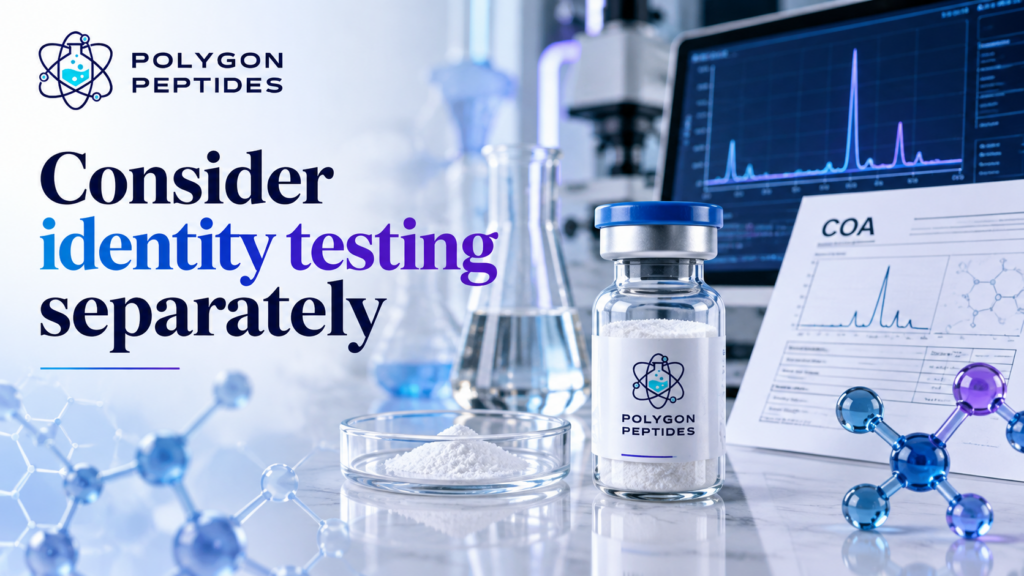
Mass spectrometry is widely used as a support for identity testing of peptides due to its ability to provide molecular-mass data. HPLC results along with mass spectrometry results, could be included in the report. The two types of analysis address complementary issues – chromatography is good for separation and purity assessment, whereas MS can help with molecular identity.
Avoid using retention time for identity testing exclusively. Retention time can be helpful for comparison within a particular method; however, reliable identification should be based on evidence relevant to the analysis goal.
5. Match the batch or lot number to the vial
Batch is one of the essential data fields in any COA because this information links the result of the analysis with the physical material.
In case a tirzepatide vial has Batch A and a report for Batch B is attached, this means that the latter is not directly related to the material being evaluated.
When checking documents, check the lot/batch number in the following documents:
- vial label;
- COA;
- product documentation or order documentation;
batch records available for download in case the company provides such documentation.
Moreover, Polygon Peptides’ COA guide also emphasizes the importance of batch-related documentation since the goal of a certificate is to show the analysis performed on what batch.
6. Check the dates of testing/documenting
COA should reflect the date of analysis performed or at least the issue date of the report. The date is needed to establish the timeline of the test.
What should be checked is not how “fresh” is this document according to some arbitrary rules from the internet. What needs to be understood is whether the report is related to the current batch and whether there are logical reasons why the dates should look like this.
An extremely old report for freshly produced
7. Laboratory doing the analysis
An effective lab report will indicate who did the testing. At a bare minimum, you should find out the laboratory name along with other details of the document which will help make it traceable.
Third party testing provides some sort of separation between a manufacturer’s claim and the test result but it should still be reviewed.
Relevant questions can include: Is the laboratory name identified? Is there an identifier of the report/sample? Is methodology specified? Can the document be traced back to the batch? Are results given in a form consistent with analytical testing?
8. Review the chromatogram, peak table, and other data
A laboratory for tirzepatide lab report becomes even more meaningful when it comes along with some analytical data that explains the headline result.
The useful supporting data may comprise such information as the chromatogram, retention times, peak areas, percentage of the peak area and integration of the main peak as well as smaller ones.
While analyzing the chromatogram, one should not look at the tallest peak but also pay attention to smaller peaks, interpret the baseline and verify if the peak table agrees with the purity result.
According to ICH, system suitability is considered an integral component of many analytical methods since the analytical system should work properly before the result is used.
The screenshot with no sample ID, axes, peak table or method description is far less reliable than an analytical record.
9. Look through the COA for internal consistency
To conduct a complete evaluation of the COA, it is necessary to test the document for its internal consistency.
Does the compound have the same name as written on the bottle? Does the batch number match? Is the method mentioned consistent with the attached chromatogram? Is the stated purity level consistent with the peak table? Is the information regarding mass spectrometry consistent with the stated identity?
These kinds of mistakes frequently show up here.
Well-prepared coa tirzepatide report should give a clear and single story from sample identification to results. If one part of the COA states HPLC and other parts contain irrelevant information and different batch numbers, there are problems with this report.
Good documentation is no substitute for experimental checks and laboratory’s criteria for COA acceptability, but it is good means to evaluate the completeness of evidence provided.
A practical checklist for reviewing COA of tirzepatide
Prior to archiving a COA report in your database, ensure:
- Tirzepatide has been clearly identified.
- The batch number is the same on both the vial and COA.
- Method of analysis has been reported.
- Supporting evidence includes HPLC purity with a chromatogram or peak information.
- The purity is not taken as total concentration of vial.
- Identity evidence has been provided separately wherever applicable.
- The lab name and report identifier are traceable.
- Test date and COA date match logically with the batch.
All pages have consistent data.
Such an approach will allow you to remain focused on the evidence rather than only a marketing percentage figure.
A COA review also allows one to make comparisons between different batches. Two different methods, detectors, or integration principles can produce two different purity percentages. Hence, researchers must be careful not to treat COAs like scorecards. Instead, they should evaluate whether a report provides sufficient information to be clear, traceable, and appropriate for the laboratory decision under consideration. The consistency in reporting will help to detect any deviations in future COAs compared with previous COAs.
Sources and References
- ICH Q2(R2), Validation of Analytical Procedures — current EMA implementation is effective from 14 June 2024 and covers principles for demonstrating analytical procedures are suitable for their intended purpose.
- ICH Q14, Analytical Procedure Development — covers science- and risk-based analytical-procedure development, including selection of analytical technology and procedure-performance considerations.
- PubChem: Tirzepatide — authoritative chemical record for tirzepatide’s molecular formula, molecular weight, and structural description.
Final perspective
A tirzepatide report would be more valuable if it presents trackable evidence, instead of a claim of purity only. Consider the structure of the compound, the HPLC procedure used, what the purity percentage means, the batch number, the dates, the origin of the lab that conducted the test, and the HPLC result itself in combination.
The tirzepatide peptides offered by Polygon Peptides UK are only to be used for in vitro research. Researchers need to use their own internal procedures and standards to analyze any research material.
FREQUENTLY ASKED QUESTIONS
A useful COA should include the product name, batch or lot number, testing date, analytical method, reported result and laboratory information. For peptide analysis, supporting chromatographic data and separate identity evidence can make the report significantly more informative.
HPLC is valuable for separation and purity assessment, but HPLC purity alone should not be treated as definitive molecular identification. Identity may be supported by complementary techniques such as mass spectrometry, depending on the analytical objective.
It is not necessarily so. HPLC area percent is the indication of detected components within the certain method. It cannot be equated to mass percent, assay, peptide mass, or the amount in the vial.
The batch number indicates the relation of the result to a certain batch of the product. The batch number printed on the vial may not correspond to the number indicated on the certificate of analysis.
The original document will be more informative than the statement itself. The researchers should examine COA, batch number, test method, and analytical data.