Introduction
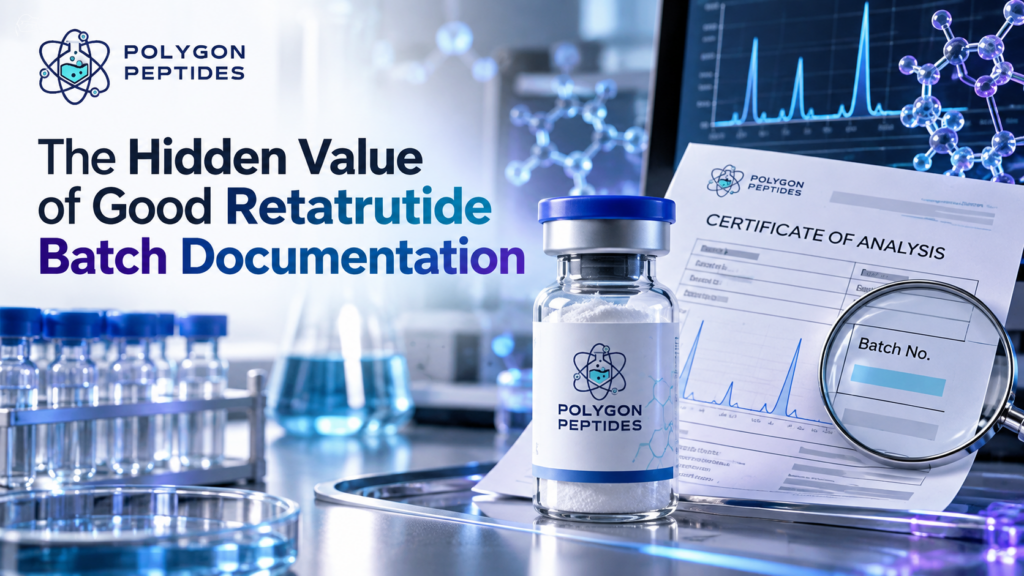
When retatrutide in the UK is evaluated in laboratories, the information provided by the vial alone is just the tip of the iceberg. While the product name, quantity, and percentage of purity might make one feel assured, there must be a body of evidence supporting the link between the physical substance and a particular batch number for the scientific evaluation to occur.
This matters particularly because retatrutide remains an investigational compound.
For research laboratories, therefore, good documentation is not simply paperwork attached to a retatrutide vial. It helps answer a much more important question:
Can the analytical evidence actually be connected to the material being examined?
Research-use notice: This article concerns laboratory documentation and analytical evidence only. It does not provide medical, dosing, injection, treatment, weight-loss, or human-use guidance. Research materials discussed here are intended strictly for appropriate laboratory and in-vitro research.
Why Batch Documentation Has More Value Than a Purity Claim
A statement such as “HPLC tested” or “high purity” gives researchers very little information on its own.
A stronger documentation package creates a chain:
Physical vial → batch number → COA → analytical result → testing laboratory
Each link answers a different question.
The vial identifies the physical research material. The batch number connects it to a particular production lot. The Certificate of Analysis records what was tested. The analytical data provides evidence from the test, while the laboratory information helps establish where and when that analysis took place.
If one of these connections is missing, interpretation becomes more difficult.
This is the hidden value of good batch documentation: it makes analytical claims traceable rather than merely visible.
The Batch Number is a Small Thing With a Big Impact
The batch or lot number refers to one manufacturing batch from another.
This is important because two vials of the same compound name may not be part of the same manufacturing batch.
For example, imagine a laboratory receives:
- Retatrutide vial: Batch RT-A104
- COA: Batch RT-A104
- HPLC report: Sample RT-A104
Those records form a reasonably coherent documentary link.
Now consider:
- Retatrutide vial: Batch RT-B218
- COA: Batch RT-A104
Even if the COA shows impressive analytical results, it does not directly document the batch printed on the physical vial.
The issue is not necessarily that either document is false. The problem is that the evidence chain is incomplete.
A batch identifier therefore gives laboratories a practical way to organise records, compare material and investigate discrepancies.
What Does COA Stand For?
COA stands for Certificate of Analysis.
A COA is a document that records analytical information relating to a particular material or batch. Depending on the laboratory and testing scope, it may contain:
- product or sample name
- batch or lot number
- sample identifier
- analytical method
- HPLC purity result
- identity-test result
- testing date
- laboratory details
- specifications or acceptance criteria
- chromatograms, spectra or other supporting records
Polygon Peptides’ own COA guidance similarly emphasises product identity, batch number, analytical method, purity information, test date and laboratory details as key pieces of batch-level documentation.
However, simply having a document labelled Certificate of Analysis is not enough. Researchers still need to examine what the document actually contains.
What a COA Can — and Cannot — Prove
A useful COA can document what a laboratory reported about the sample submitted for testing.
For example, it can show that:
- a particular sample identifier was tested;
- a specified analytical procedure was used;
- a particular result was obtained;
- the testing occurred on a recorded date; and
- the testing laboratory produced the report.
But a COA should not be treated as universal proof of everything about a material.
A COA does not automatically prove:
- that every vial from a production batch is chemically identical;
- that the sample submitted to the laboratory is unquestionably the same vial now being examined;
- that the compound is suitable for human use;
- that an HPLC purity result independently confirms molecular identity;
- that material remained unchanged after the reported testing date;
- that storage and transport conditions were appropriate after testing.
This distinction is important.
A COA is analytical documentation, not an unlimited guarantee.
The most useful question is therefore not simply:
“Is there a COA?”
It is:
“What does this COA demonstrate, and how confidently can it be connected to this batch?
HPLC Purity Data Needs Context
ICH’s Q2(R2) guideline specifically includes chromatographic separation techniques within analytical procedures used for purity, impurity, and assay-related purposes. The guideline also stresses that analytical procedures should demonstrate appropriate specificity or selectivity for their intended purpose.
Why the chromatogram matters
A reported percentage is the conclusion.
The chromatogram is part of the underlying analytical evidence.
A chromatographic trace can show how components were separated and provide researchers with more information than a standalone statement such as “99% pure”.
However, chromatograms also require interpretation. A visually dominant peak does not by itself prove that the peak corresponds to retatrutide.
That leads to another important distinction.
Purity and Identity Answer Different Questions
One of the easiest mistakes in peptide documentation is treating purity testing and identity testing as interchangeable.
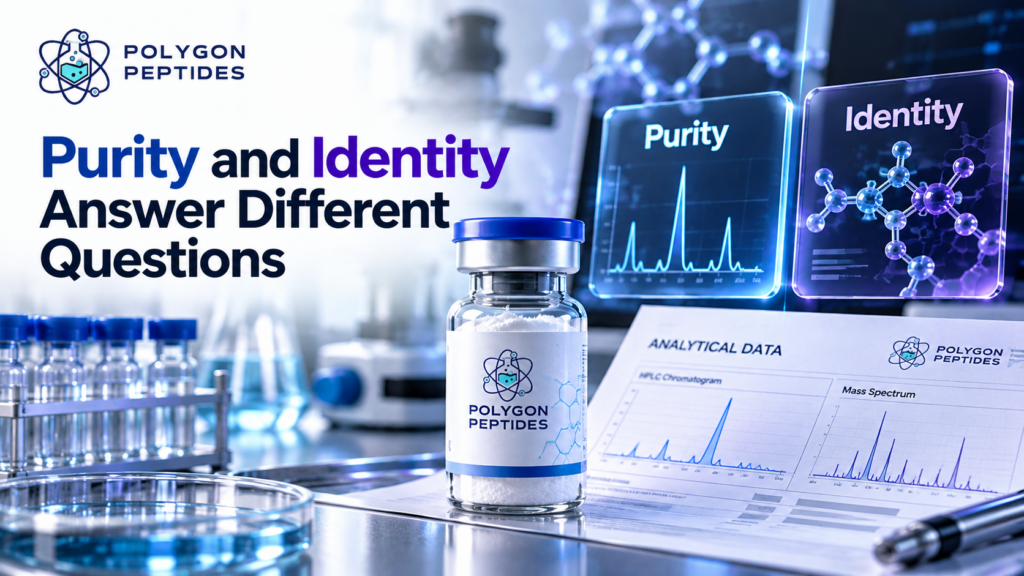
They are not.
Purity asks:
How much of the detected chromatographic material corresponds to the principal component under the reported analytical conditions?
Identity asks:
Is the material actually the compound it is claimed to be?
ICH Q2(R2) states that identification procedures should demonstrate the ability to identify an analyte using characteristics related to its molecular structure or other specific properties. It also notes that where one analytical procedure does not provide sufficient discrimination, more than one procedure may be appropriate.
That principle is especially relevant when reading peptide documentation.
An HPLC purity figure can provide useful information about chromatographic purity, but researchers should avoid interpreting that figure as complete molecular identification unless suitable identity evidence accompanies it.
Why Identity Testing Strengthens the Documentation Package
Retatrutide has a specific molecular identity and is also known by identifiers including LY3437943. Government-linked PubChem records list retatrutide and associated identifiers, providing a useful independent reference point for compound identity.
Analytical identity evidence may involve techniques selected according to the material, method, and research objective.
For peptides, laboratories may use complementary analytical approaches because they answer different questions.
For example:
HPLC
Useful for chromatographic separation and purity-related assessment.
Mass spectrometry
Can provide molecular-mass information that supports identification.
The value comes from orthogonal evidence: two analytical approaches based on different measurement principles can strengthen the overall analytical picture.
ICH Q2(R2) specifically discusses comparison with a second well-characterised procedure using a different measurement principle when greater specificity is needed.
That is why “tested” is much less informative than knowing what was tested, by which method, and for what analytical purpose.
The Testing Date Adds Necessary Context
Testing dates can easily be overlooked when researchers concentrate on purity numbers.
Yet a test result describes a sample at a particular point in time.
The date allows researchers to ask:
- When was this batch analysed?
- Does the report correspond to the current batch?
- Was the testing completed before the material entered the laboratory?
- Is an old report being reused for newer material?
- Are multiple reports available from different dates?
A testing date does not tell researchers everything about what happened before or after analysis, but its absence removes useful context.
The combination of batch number + sample identity + testing date is considerably more informative than a purity percentage without those details.
Laboratory Information Should Be Verifiable
Good documentation should make it reasonably clear who produced the analytical result.
Researchers can look for information such as:
- laboratory name
- report or certificate reference
- test date
- analytical method
- sample identifier
- contact or verification information where appropriate
Matching a COA to a Retatrutide Vial
One of the simplest documentation checks is also one of the most valuable.
Take the physical retatrutide vial and compare it directly with the supporting report.
Check these details side by side:
| Vial or Product Record | COA / Analytical Report |
| Compound name | Compound/sample name |
| Batch number | Batch/lot number |
| Product or sample code | Sample/report identifier |
| Quantity or presentation | Relevant sample description |
| Supplier reference | Report reference where provided |
The most important match is usually the batch or lot identifier.
Polygon’s Retatrutide product page currently identifies the material as research-use-only and states that analytical documentation is available for the product.
Traceability Is Really About Reconstructing the Evidence Trail
Good traceability means another qualified person should be able to return to the laboratory records later and understand what happened.
For example:
Sample received
↓
Batch RT-104 recorded
↓
COA RT-104 reviewed
↓
HPLC record checked
↓
Identity evidence reviewed
↓
Laboratory and test date recorded
This becomes particularly useful if an experiment produces an unexpected result.
Instead of relying on memory, researchers can return to the documentation and determine exactly which batch entered the workflow.
That ability to reconstruct the evidence trail is one reason documentation has value beyond procurement.
A Strong Document Package Uses Several Pieces of Evidence
No single field should carry the entire quality assessment.
A useful way to think about documentation is through three layers.
Layer 1: Physical identification
This includes the vial label, compound name, product code, and batch number.
It answers:
Which physical material do we have?
Layer 2: Analytical evidence
This may include HPLC data, purity results, and suitable identity information.
It answers:
What did the analytical testing show?
Layer 3: Documentary provenance
This includes the test date, laboratory information, report number, and relationship between the certificate and batch.
Documentation Red Flags Worth Investigating
Researchers reviewing research peptides UK retatrutide documentation can look for inconsistencies rather than simply searching for an impressive number.
Common warning signs include:
- no batch or lot number;
- batch number on the COA does not match the vial;
- no testing date;
- unidentified laboratory;
- “lab tested” with no analytical documentation;
- purity percentage with no stated method;
- chromatogram with no identifiable sample reference;
- compound name inconsistent across documents;
- COA that appears to be a generic example rather than batch-specific evidence;
- HPLC purity being presented as complete proof of identity;
- analytical results copied across apparently different batches without explanation;
- cropped documents that remove useful report details;
- unclear relationship between the supplier, testing laboratory and report.
One red flag does not automatically establish that a research material is unsuitable.
It means the documentation deserves clarification.
Practical Retatrutide Documentation Checklist
Before adding research material to a laboratory record, check whether you can answer the following.
Sample identification
- Is the compound clearly identified?
- Is the batch or lot number visible?
- Does the vial identifier match the accompanying documentation?
COA
- Is a batch-specific Certificate of Analysis available?
- Does the COA state the analytical method?
- Is the test date provided?
- Is the testing laboratory identified?
Purity evidence
- Is the reported purity linked to an HPLC analysis?
- Is supporting chromatographic information available?
- Is it clear what the reported percentage represents?
Identity evidence
- Is there analytical evidence addressing molecular identity rather than purity alone?
- Are the methods and results clearly described?
Traceability
- Can the vial, batch, report, and analytical data be connected?
- Could another researcher reconstruct the same evidence trail later?
If several answers are “no”, the problem is not necessarily the material itself—it is that the available evidence does not allow a strong documentary assessment.
Why Documentation Should Come Before Commercial Comparison
Researchers sometimes begin with searches such as where to buy retatrutide UK and then compare suppliers by availability or price.
For legitimate laboratory procurement, those factors should not replace an evidence review.
Good Documentation Does Not Need to Be Complicated
Strong batch documentation is not about producing the longest certificate.
It is about making the relevant information easy to connect.
A concise report containing clear sample identification, batch information, testing methodology, analytical results, test dates, and laboratory information can be more useful than pages of generic quality statements.
For retatrutide in the UK used within legitimate laboratory research, analytical transparency should therefore be viewed as part of the material’s scientific record rather than an optional marketing feature.
Authoritative Sources
- ICH Q2(R2): Validation of Analytical Procedures — official guidance covering identification, specificity/selectivity, purity, impurities, and complementary analytical procedures.
- ICH Quality Guidelines — official overview covering analytical validation, specifications, impurities, and pharmaceutical quality principles.
- PubChem – Retatrutide — authoritative chemical/substance identity information and identifiers for Retatrutide/LY3437943.
- Eli Lilly – What to Know About Retatrutide — current developer information confirming Retatrutide’s investigational status as of 2026.
FREQUENTLY ASKED QUESTIONS
COA means “Certificate of Analysis”. This certificate provides information on the analysis of the sample or lot, which may include batch number, test methodology, purity percentage, identity-related information, date of testing, and laboratory details.
Not necessarily. HPLC can provide valuable information about chromatographic purity, but purity and molecular identity are different analytical questions.
Matching identifiers help establish that the analytical report relates to the same production lot as the physical material being examined. If the numbers differ, researchers should clarify the relationship before treating the COA as evidence for that particular vial.
Not by itself. A COA is one part of the evidence package. Researchers should consider the sample identity, batch relationship, analytical methods, supporting data, testing date, and laboratory provenance together.
The testing date shows when the reported analysis was performed. It helps laboratories determine whether documentation relates to the current batch and provides chronological context for the analytical result.