Introduction
While a research-grade ipamorelin peptide can come with a very high purity percentage, it is important to remember that this figure should only serve as part of the evidence from your analysis, not a verdict for the sample itself. When conducting experiments, scientists require not only information about how prominent a particular chromatographic peak is. Also, proof of correct molecular constitution and suitable analytical methods for the investigation in question have to be provided by the scientists.
Its defined molecular structure makes identity particularly important: analytical purity and molecular identity answer related, but fundamentally different, questions.
What Does Purity Mean For Ipamorelin Sample Research?
The result is a graph, called a chromatogram, that shows peaks for each component that was detected under those specific conditions. This helps us see what’s in the sample and how much of each thing is there.
A large principal peak may indicate that one component dominates the detected material. Smaller peaks may represent related substances, degradation products, synthesis-derived impurities, or other detectable components.
What HPLC Can Tell Researchers
HPLC is valuable because it can separate components that might otherwise appear to be a single material.
For peptide research, an HPLC report may help researchers assess:
- the prominence of the principal chromatographic peak;
- detectable secondary peaks;
- relative peak areas under the stated method;
- retention behaviour;
- potential differences between samples or batches;
- whether a material appears chromatographically consistent under defined conditions.
This makes the chromatogram itself useful.
The distinction is important when assessing an ipamorelin 10mg research peptide or any other labelled research sample. The amount printed on a vial describes the nominal quantity supplied; it does not replace analytical evidence concerning composition or identity.
What HPLC Purity Cannot Prove on Its Own?
A clean-looking chromatogram should not automatically be interpreted as complete proof that the principal component is chemically correct.
HPLC can demonstrate separation behaviour and help quantify detectable components under a particular method. But chromatographic purity alone does not necessarily establish:
- the exact molecular identity of the main peak;
- the expected molecular mass;
- the complete peptide sequence;
- the absence of every possible contaminant;
- the absence of a substance that is not detected effectively by that method;
- the authenticity of the material represented by the documentation.
Regulatory analytical guidance makes a similar distinction. FDA guidance states that identification based solely on a single chromatographic retention time is not considered sufficiently specific and describes combined or complementary analytical approaches as stronger evidence for identification.
This leads to one of the most useful questions in peptide quality assessment.
Purity and Identity Ask Two Different Questions
Consider these two questions:
How much of the detected material appears to belong to the principal chromatographic component?
and:
Is that principal component actually Ipamorelin?
They are not interchangeable.
The first is primarily a purity or impurity-profile question.
The second is an identity question.
Why Identity Testing Adds Another Layer of Evidence
Mass spectrometry is one analytical technique commonly used for peptide characterisation because it provides information related to molecular mass.
Research on peptide reference standards demonstrates the value of combining techniques rather than expecting one measurement to answer every quality question. Published work from the United States Pharmacopeia describes analytical strategies using methods including mass spectrometry, chromatography and NMR when establishing peptide reference materials and confirming identity.
This does not mean that one mass spectrum answers every analytical question either.
Instead, it demonstrates a broader principle: different analytical methods provide different types of evidence.
Chromatography may provide information about separation and relative impurities. Mass spectrometry may provide information supporting molecular identity. Other techniques may address still other characteristics.
When those pieces agree, the analytical picture becomes more informative.
The Method Matters as Much as the Number
A purity percentage looks precise. That precision can create a false sense of completeness if the testing method is not described.
Two laboratories can analyse similar materials using different conditions and obtain chromatograms that are not directly comparable.
Consequently, scientists need to consider more than just the percent and inquire:
What type of analysis was performed?
Was the analysis appropriate to its purpose?
How was the chromatogram integrated?
Is the analytical procedure described?
Was the identity assessed separately?
Could relevant impurities co-elute with the principal component?
Peptide impurity profiling is actually more complicated than one would expect from a typical HPLC trace. This is precisely why the combination of chromatography and mass spectrometry techniques is becoming common in peptide characterization. The FDA has even utilized LC-MS/MS and HRMS techniques in peptide impurity detection and profiling studies.
Why a Certificate of Analysis Needs Context
A Certificate of Analysis, normally shortened to COA, is one of the most useful pieces of documentation attached to a research peptide when it is properly linked to the tested material.
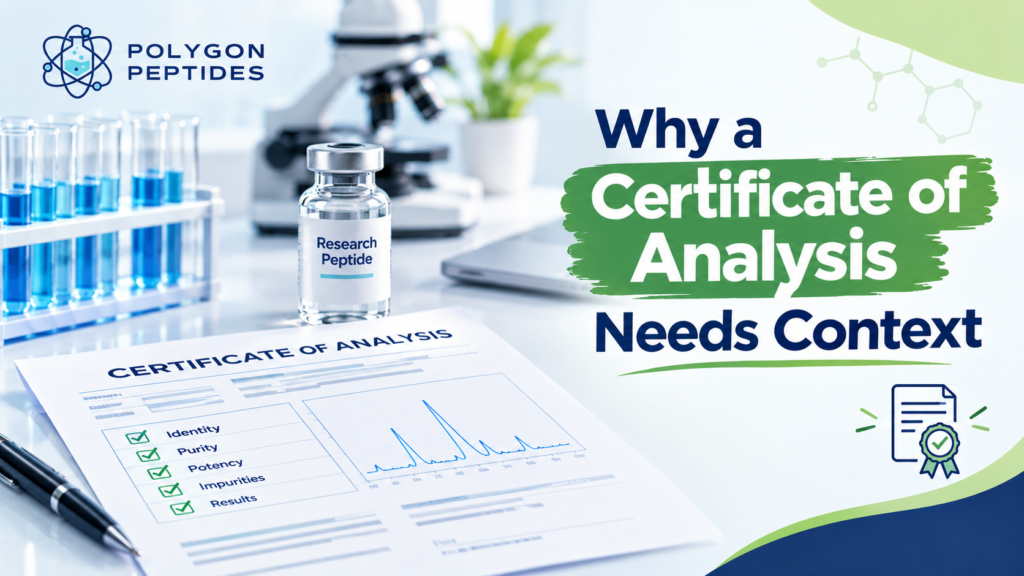
A useful COA may include:
- product or material name;
- batch or lot number;
- analytical method;
- purity result;
- testing date;
- laboratory information;
- chromatographic data;
- identity-testing results where available.
The document should help a researcher follow the analytical evidence from the physical sample back to the test record.
That is the important point.
A COA should not simply be viewed as a sheet containing a large percentage.
It should help establish traceability.
Is the COA Consistent with the Real Ipamorelin Sample?
Suppose you have a vial stamped as Batch IP-2407, yet your COA is that of Batch IP-2311.
Regardless of how impressive the information on the earlier document is, it cannot confirm the analytical properties of the new one.
The same principle applies to an ipamorelin peptide for sale through a research supplier. Researchers evaluating the material should be interested not merely in whether a COA exists, but whether the document can be connected to the material actually supplied.
For Polygon Peptides, the existing COA guidance similarly emphasises matching batch information between the research material and its analytical documentation.
Useful traceability may involve checking:
- the product name;
- batch or lot identifier;
- test date;
- stated quantity or sample description;
- laboratory reference;
- accompanying analytical data.
A mismatch does not automatically establish that the material is unsuitable. It does mean that further clarification may be necessary before the document is treated as evidence for that particular batch.
“High Purity” Is a Starting Point, Not the Entire Quality Story
Researchers encountering phrases such as high purity ipamorelin should ask what evidence sits behind the statement.
A number without context leaves several unanswered questions.
Was the material analysed using HPLC?
Is the chromatogram available?
Does the report identify the sample batch?
Was identity assessed separately?
Who carried out the analysis?
When was it performed?
Does the documentation correspond to the material currently supplied?
These questions are especially relevant when comparing ipamorelin research peptide companies or conducting ipamorelin peptide supplier research. A supplier comparison based entirely on a headline purity figure may overlook differences in documentation quality and traceability.
Likewise, someone searching where to buy ipamorelin for legitimate laboratory research should treat analytical transparency as a separate consideration from price, packaging, or availability.
The useful question is not simply, “Which supplier reports the largest number?”
It is, “What evidence explains and supports that number?”
Documentation Red Flags Worth Investigating
No single documentation issue automatically proves that a research sample is unsuitable. Some issues may have straightforward explanations.

However, certain gaps should trigger further verification.
No identifiable batch number
Without a batch or lot reference, it can be difficult to connect analytical results to a particular production batch.
Purity percentage with no supporting chromatogram
A number alone gives little information about chromatographic separation, minor peaks, or the underlying analytical output.
No testing date
The researcher cannot easily determine when the reported analysis was conducted or whether it relates to current stock.
No analytical method
“Tested” is not a method. The documentation should make clear what technique produced the stated result.
Identity and purity treated as the same measurement
A high HPLC purity result should not automatically be presented as equivalent to complete molecular identity confirmation.
Unclear laboratory information
Researchers should be able to understand where the analytical record originated and, where appropriate, how to verify it.
Batch numbers that do not match
The identifier on the research vial should correspond with the documentation presented for that batch.
Repeated generic documentation
A document reused across unrelated batches provides weaker batch-specific traceability than an analytical record clearly connected to the material being supplied.
What to Check Beyond the Purity Percentage
Before treating a purity figure as meaningful evidence, researchers can work through a simple review:
- Is the peptide identity supported analytically?
- Is the HPLC method identified?
- Is the chromatogram available?
- Does the COA refer to a specific lot or batch?
- Does that batch match the research sample?
- Is the testing date visible?
- Is the testing laboratory identified?
- Are identity and purity reported as separate analytical questions?
- Is there enough information to trace the document to the physical material?
- Are unusual peaks, limitations, or inconsistencies explained where necessary?
This type of review gives researchers more useful information than comparing percentages in isolation.
So, Does a High Purity Percentage Tell the Full Ipamorelin Story?
No single analytical number should be expected to carry the entire assessment.
A high reported HPLC purity result can be useful evidence about the chromatographic composition of an Ipamorelin research sample under the method used. It does not, by itself, answer every question about molecular identity, impurity characterisation, batch traceability or documentation quality.
For laboratory work, the stronger picture comes from connecting the evidence.
Purity tells one part of the story. Identity testing helps establish what the material is. The analytical method explains how the result was obtained. The COA records the findings. The batch number connects those findings to the physical research sample.
Together, those details provide a much more meaningful basis for evaluating research material than a percentage printed in isolation.
This article is provided for laboratory, analytical, and educational reference only. It does not provide dosing, treatment, medical, or human-use guidance.
Authoritative Sources
- Raun K, et al. — “Ipamorelin, the first selective growth hormone secretagogue.” European Journal of Endocrinology, 1998. Establishes the published molecular description of Ipamorelin as a pentapeptide.
- PubChem — Ipamorelin, CID 9831659. Provides chemical identity, molecular formula, molecular weight, and structural information.
- ICH Q2(R2): Validation of Analytical Procedures. International guidance covering validation concepts for analytical procedures used for identity, purity, and impurity measurements.
- FDA — Q6A Specifications: Test Procedures and Acceptance Criteria. Particularly relevant to the distinction between chromatographic behaviour and sufficiently specific identity testing.
- FDA — Analytical Procedures and Methods Validation for Drugs and Biologics. Guidance covering analytical evidence for identity, strength, quality, purity and potency.
FREQUENTLY ASKED QUESTIONS
It generally describes the proportion of the principal detected component relative to other detectable components under the conditions of the chromatographic method used.
HPLC can provide useful chromatographic evidence, but a single chromatographic retention result should not be treated as complete identity confirmation.
Purity and identity answer different questions. A sample can show a dominant chromatographic peak while still requiring evidence that the dominant component has the expected molecular characteristics.
Important information to find would be the substance name, batch/lot number, testing method, purity results, testing date, lab info, and chromatogram ID info, when available.
No, not always. It is the percentage that matters, but there is more that should be taken into account in the case of the research sample.