Introduction
The semaglutide peptide is regarded as an interesting topic because it attracts many scientists because of the molecular characteristics of this peptide and use in experiments. Scientists continue to study this peptide and how it behaves for gaining more information about this peptide and its reaction in experimental settings. With the rise in peptides research, the investigation of **semaglutide peptide** will add a lot to the current research on peptides.
What Is Semaglutide?
Semaglutide is a synthetic peptide analogue of GLP-1 that is a natural hormone found in humans.
The wording “Semaglutide UK” can come up in searches for information about semaglutide and products available in the UK. However, the context matters. A product containing semaglutide that is intended for research should not simply be treated as the same thing as an authorised medicine. Their intended uses and regulatory requirements can be quite different.
Research materials should not be presented as medicine or as medicine suitable for humans or animals.
Why Semaglutide Matters in Peptide Research
This peptide is a valuable research tool for structural studies, receptor interactions, analytical characterization, and related biochemical research. Low level impurities of semaglutide such as D-aminoacid isomers have been studied in published analytical work, which involved reverse phase chromatography and high resolution mass spectrometry.
This is a good reminder that the characterisation of a peptide may not be so straightforward as saying that a sample contains something with the expected name.
Analytical methods can provide different types of evidence about identity, purity and impurities.
For researchers working with semaglutide peptides, therefore, documentation should accompany the material throughout the laboratory workflow.
Semaglutide Peptide Characteristics
Research data that can be useful for identification can be the compound name, the molecular formula, the molecular mass, sequence data, and other descriptors that describe molecular structure.
The molecular weight of semaglutide is listed in PubChem as ~4114g/mol. Due to its relatively large size and peptide structure, the analytical characterisation of this material needs methods suitable for complex peptide materials.
The analytical needs will vary according to the research goal. The analytical result of one item must not be used to assume the presence of all quality attributes.
Why Batch Numbers Matter
A batch or lot number creates the connection between a physical research material and its supporting documentation.
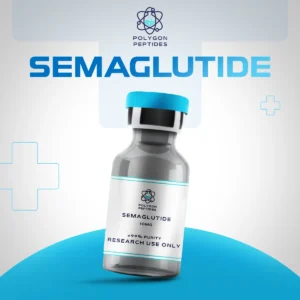
For example, a researcher may receive a semaglutide 10mg vial carrying a specific lot number. The relevant documentation should use the same identifying reference. This enables the researcher to relate the material to the analytical report, the date of the test, and the records of the test.
This is particularly useful if experiments are required to be repeated, results are to be reviewed, or if a question is raised about a specific material.
The following are useful elements in a usable record:
- Product or compound name
- Batch or lot number
- Date received
- Testing date
- Reported analytical results
- Testing laboratory
- Relevant storage information
- Associated COA or laboratory report
Understanding a Certificate of Analysis
A Certificate of Analysis (COA) is a document that reports analytical information relating to a particular product or batch. It includes various things such as compound name, batch number, analytical method, specifications, results, testing date, and laboratory information, depending on the laboratory and material. For research materials, a batch-specific COA is considerably more useful than a generic document because it can be connected to the material actually received.
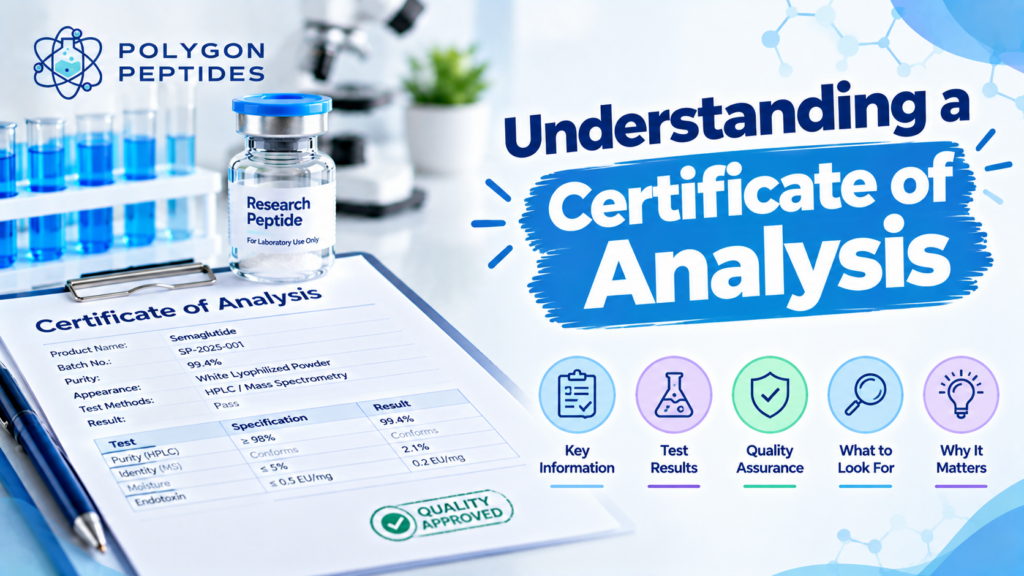
ICH guidance also emphasises the importance of characterised and traceable reference standards, with COAs providing information such as purity, storage conditions, retest or expiry information, and batch numbers.
What a COA Can and Cannot Prove
A COA provides analytical evidence, but it should not be treated as a universal guarantee of every characteristic of a research material.
For instance, a purity result might be a result from a specific method of analysis performed under specific testing conditions. Does not necessarily imply all possible attributes; e.g., long-term stability, suitability for a specific experiment, or performance in a biological system.
The researchers should therefore think of using a COA in conjunction with the product identity, batch information, analytical methodology, and laboratory records.
HPLC Purity Data
High-Performance Liquid Chromatography (HPLC) is a highly popular method for determining peptide purity and for the separation of the constituents of a sample. Chromatographic techniques may be employed to resolve a mixture of the main peptide and related substances and impurities in semaglutide research.
Published research demonstrates the use of advanced liquid-chromatography and mass-spectrometry techniques to investigate semaglutide-related impurities.
When reviewing an HPLC result, researchers should look beyond a single percentage. The report should ideally identify the material tested, the batch, testing method, and relevant laboratory information.
Identity Testing Adds Another Layer of Evidence
Purity and identity are different analytical questions.
A purity test evaluates the relative presence of the principal component and other detected components under the stated analytical conditions. Identity testing addresses whether the material corresponds to the expected compound.
For this reason, researchers should avoid treating an HPLC percentage alone as complete proof of molecular identity.
Testing Date and Laboratory Information
The testing date helps establish when the reported analytical result was generated. This becomes useful when comparing documentation with current laboratory inventory.
Laboratory information is also important because it identifies the organisation associated with the testing. A transparent report should make it possible to understand who performed the analysis and which methods were used.
USP guidance similarly describes batch-specific COAs as authentic documentation and notes the importance of information such as the material name, batch number, and release date.
Matching a COA With a Semaglutide Vial
Before placing a research material into laboratory inventory, researchers can perform a straightforward documentation check:
- Compare the compound name on the vial with the COA.
- Match the batch or lot number exactly.
- Check the reported testing date.
- Review the analytical method used.
- Examine the reported purity and identity information.
- Confirm that the testing laboratory is clearly identified.
- Record the documentation with the laboratory inventory.
A mismatch between a vial label and COA should be clarified rather than ignored.
Common Documentation Red Flags
Several documentation issues deserve closer attention:
- Generic COAs that do not identify a batch
- Missing testing dates
- No identifiable testing laboratory
- Product names that differ between documents
- Batch numbers that do not match the vial
- Purity claims without an identified analytical method
- Documents containing unexplained inconsistencies
- Marketing claims that go beyond the analytical evidence
A professional-looking PDF alone does not establish analytical validity. The usefulness of documentation depends on its traceability and the evidence it actually contains.
A Practical Research Documentation Checklist
For semaglutide research, researchers can ask:
Is the compound a definite compound in the question? Is the compound clearly stated in the question?

Traceability: Are there any batch numbers linking the vial to the COA?
Purity: Does the analytical method clearly go with the purity?
Identity: Is the compound clearly identified?
Traceability: Does the batch number connect the vial to the COA?
Purity: Is the analytical method clearly stated?
Identity testing: Is there supporting evidence beyond a simple purity percentage?
Laboratory: Is the testing organisation identified?
Date: Is the testing date provided?
Consistency: Do the vial, product information, and COA agree?
Records: Can the documentation be retained with the laboratory’s material records?
This evidence-based approach helps separate analytical information from promotional claims.
Research-Only Positioning
Medicines are different from those used in the scientific research and have only been authorised for medicinal use in the UK and EU. The EMA has found the compound semaglutide to be the active ingredient in the authorised medicines Wegovy, Ozempic and Rybelsus.
Research-grade materials discussed in this context are intended strictly for laboratory and in vitro research. This article does not provide dosing, administration, treatment, or human-use guidance.
Authoritative Sources:
- PubChem — Semaglutide
- European Medicines Agency — Wegovy
- European Medicines Agency — Ozempic
- PubMed — Semaglutide impurity characterisation
- ICH — M10 Bioanalytical Method Validation
- USP — Pharmaceutical Ingredient Verification Guidance
FREQUENTLY ASKED QUESTIONS
Semaglutide is a synthetic GLP-1 analogue and peptide that has been well researched in the field of pharmaceutical and biochemical studies.
Yes. Semaglutide is a polypeptide (a protein that is modified and has a specified sequence of amino acids).
A batch number connects a physical research material to its analytical documentation: it assists in keeping laboratory records organised and helps to ensure traceability.
The information of purity can be helpful with HPLC; however, identity, impurities, and other properties may require other analytical methods.
The researchers are to verify the identity of the product, batch number, date of testing, analytical method, results, and the identifiable testing laboratory, and compare these with the material received.