Introduction
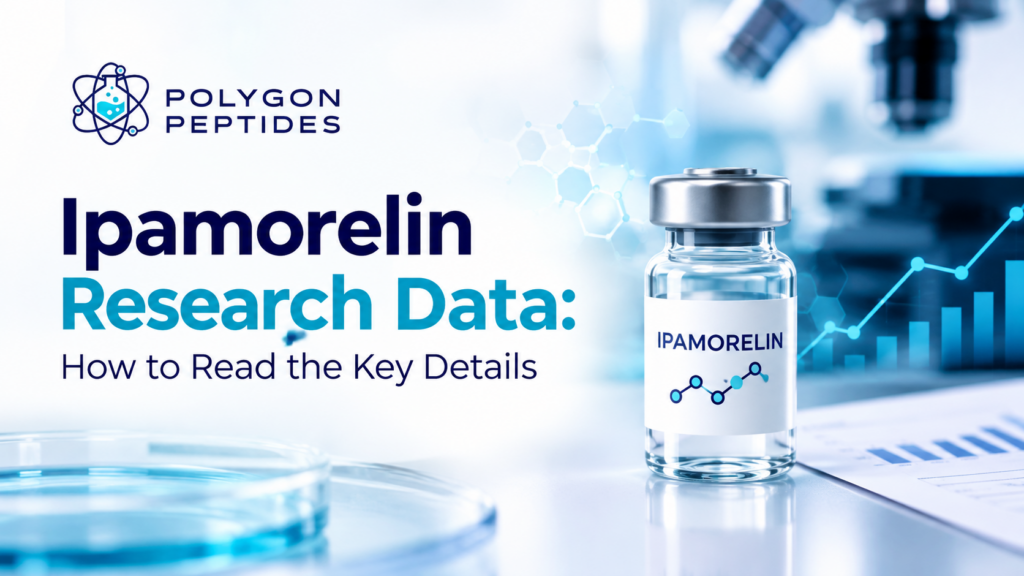
“Analysis of Ipamorelin Research Data” involves more than just seeing a purity level number or taking a laboratory certificate for granted. Analytical data consist of several different things, and each of them provides an answer to a separate question about a peptide sample. There is information that helps recognize the peptide, information on the chromatographic pattern, mass measurement, and batch records.
The correct interpretation of this data by researchers and laboratory specialists is crucial when evaluating the strengths and weaknesses of analytical evidence. A reported result always needs to be looked at with regard to the analytical method, sample in question, and laboratory records. It is also very important to differentiate measured data from assumptions and advertisements.
The following guide will help you interpret peptide research reports, learn about analytical methods, and review a “Certificate of Analysis (CoA)“.
What Is Ipamorelin Peptide?
What is “ipamorelin peptide” in terms of science? Ipamorelin is defined as a synthetic pentapeptide, which has five amino acid-like building blocks. The peptide is considered to be part of the family of growth hormone secretagogues, compounds which were studied for the purpose of stimulating the secretion of growth hormone.
Ipamorelin’s properties and its action were studied in the publication “European Journal of Endocrinology in 1998. The compound’s action is associated with growth hormone secretagogue receptors, which in turn are involved in ghrelin hormone activity.
It can be analyzed by scientists in terms of the compound’s molecular structure, its receptor activity, stability, and its analytical characteristics. Nonetheless, merely discovering the molecular structure of a substance or witnessing its effect in the lab setting does not mean that it is safe and effective to be used in therapy.
What Does Ipamorelin Research Data Actually Show?
Types of Ipamorelin Research Data
There can be many types of evidence included in the analysis, depending on the nature of the research and type of analysis performed.
In a lab report, one would find:
- Chemical identity – whether the measured parameters match the chemical.
- Purity – ratio of peaks in chromatography under certain analytical conditions.
- Molecular weight – whether the measured weight matches the molecular composition.
- Batch details – identifiers of the batch along with the date of the test and other details for traceability.
- Experimental results – the findings obtained as part of the scientific study.
The above-mentioned categories are not equivalent to each other. One cannot equate the chemical identity of the compound with its quantity present in a batch. Nor can the purity of the compound establish biological activity.
5 Key Details to Check in Ipamorelin Research Data
1. Peptide Identity and Sequence
The first concern is whether the sample matches the desired compound. Product names alone would not be enough because they might lack sufficient information or may even fail to be consistent with the chemical being tested.
The identity of the chemical can be determined by comparing its analysis to the characteristics of molecules, standard substances, and sequence data.
For cases where sequence identity is important, see if the analytical technique used provides enough information for that.
2. Purity Results and Their Meaning
Purity levels tend to be some of the first numbers that leap out at someone viewing a peptide analysis. The definition of a stated purity percentage will vary from lab to lab depending on how it was determined.
An example of a chromatographic purity reading might be a description of the fraction of the signal detected in relation to the total signal generated by the detector as a function of a certain peak. The number is not necessarily the mass percent of the desired molecule within the substance.
Do not assume that a high purity level implies potency, sterility, or any other safety-related factor when analyzing a purity percentage.
3. Understanding HPLC Reports
High-Performance Liquid Chromatography (HPLC) separates components as the sample moves through a column. Detection gives rise to signals that are usually plotted in the form of peaks on the chromatogram.
Some factors contribute to the interpretation of the above findings:
Chromatographic peaks: Signals corresponding to the components identified through the procedure used.
Retention time: The time required for a component to move through the system and be detected.
Peak integration: Calculations of the area under the peak.
Purity reported: Calculation of purity using the procedure in place in the laboratory.
Retention time may be used in identification based on comparison with appropriate reference materials under similar conditions. It does not provide conclusive evidence of identification.
4. Mass Spectrometry and Molecular Identification
Mass spectrometry (MS) technique is able to measure ions based on their mass/charge ratio. It may assist scientists in checking whether the molecular properties identified are as expected.
For peptides, the tandem MS and high-resolution MS techniques may be used. The tandem MS technique focuses on examining fragments of the selected ions, which gives information regarding molecular properties and sequence-related properties.
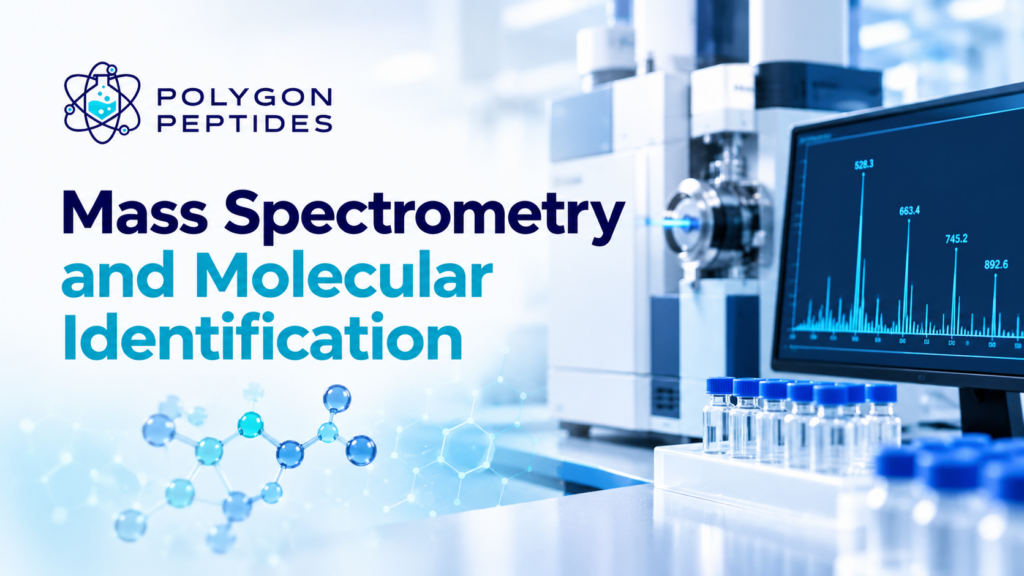
Published scientific studies have illustrated the identification and characterization of Ipamorelin using the liquid chromatography-high-resolution mass spectrometry method.
5. Batch Numbers and Documentation
Analytical data is considered valuable only when there is an ability to relate the substance tested to the sample or batch.
Study the following documentation parameters:
- Number of batch or lot.
- Dates of sample and report.
- Name of the laboratory and its identification.
- Analytical procedure and results.
- Acceptance criteria, if any.
- Identification of the tested material.
The batch number mentioned in the report must match the batch under evaluation. The document related to some other lot does not necessarily prove the features of the current material.
Presentation of the report is a valuable thing, but it is not enough to provide authenticity or independent verification.
How to Interpret an Ipamorelin Certificate of Analysis
The Certificate of Analysis (CoA) describes specific tests that have been carried out for a given sample, providing the results of these tests.
When checking a CoA, consider the following items:
- Product/Batch Identification: Make sure the information matches the product/lot to be reviewed.
- Test Methods: Find out which tests were used and what they prove.
- Results and Units: Take into consideration every result provided, along with units used and their meaning according to the particular test.
- Acceptance Criteria: See whether the results comply with the stated requirements.
A certificate is not able to prove untested properties.
Does Ipamorelin Research Data Prove That It Really Works?
The question does ipamorelin really works cannot be answered by a purity report or molecular identification result alone.
Different types of evidence answer different questions. Lab experiments can look at molecular interactions and biological activity in a controlled setting. Animal experiments can determine what happens in an animal, but well-conducted human clinical trials would be necessary to determine how things work in humans.
Researchers have to take into account the design of the study, sample size, controls, reproducibility, and applicability to the particular question that is being asked.
The bottom line here is rather obvious: evidence for the chemical identity is not sufficient proof of effectiveness, and lab observations cannot be used as such.
Conclusion
“Ipamorelin Research Data” must be understood in the context of their meaning. “Peptide ID and purity” represent separate issues; while HPLC and Mass Spectroscopy provide supplementary information, but not interchangeable proof.
The “Certificate of Analysis” is most valuable when it is possible to verify its authenticity, methodology, dates, and batch numbers. Scientists need to differentiate the issue of chemical properties from the issue of biological effects.
Readers evaluating the research data provided by “Polygon Peptides UK” need to do the same.