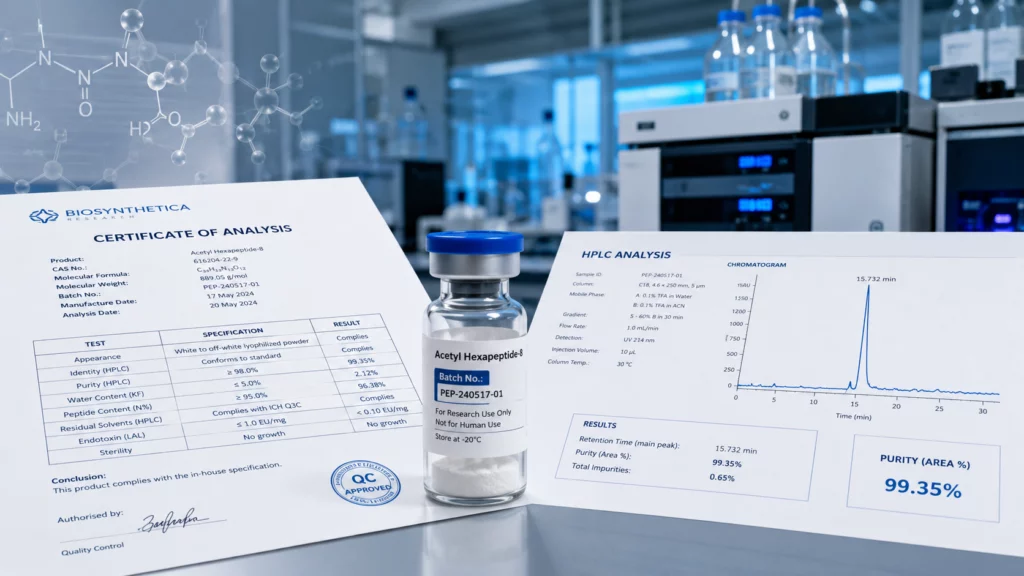
A certificate of analysis COA is a document that shows testing information for a specific product batch. In peptide research, it helps connect a research peptide to its purity data, batch number, test method and laboratory results.
In simple words, a COA tells you what was tested, which batch was tested, how it was tested and what the result showed.
For research peptides, this matters because a product label alone does not show the full testing picture. A label may show the product name and amount, but the certificate of analysis COA gives the supporting data behind that batch.
At Polygon Peptides, products are supplied strictly for laboratory and in-vitro research use only. This article does not provide medical, clinical, diagnostic, dosing or human-use guidance.
Quick Summary
| COA Detail | What It Shows |
|---|---|
| Product name | What material was tested |
| Batch or lot number | Which exact batch was tested |
| Test method | How the material was analysed |
| Purity result | The reported purity percentage |
| Testing date | When the test was completed |
| Lab details | Who performed the analysis |
| Chromatogram | Visual support for the test result |
Why a Certificate of Analysis COA Matters
A certificate of analysis COA matters because research work depends on clear documentation. If two batches are compared, each batch should have its own testing record.
A good COA helps answer important questions:
What material was tested?
Which batch does the report belong to?
What purity was reported?
Which method was used?
Was the test performed by a named lab?
Without these details, traceability becomes weaker. That is why a COA is not just an extra document. It is part of responsible research product documentation.
For more detail, read Polygon’s guide on the importance of HPLC testing in peptide research.
What Should a COA Include?
A useful certificate of analysis COA should include:
Product name
Batch number or lot number
Testing date
Test method
Purity result
Laboratory name
Specification or expected result
Actual result
Chromatogram or supporting data where available
A simple claim like “99% pure” is not enough on its own. A stronger COA should show the batch number, method and supporting result.
For general laboratory documentation context, NIST reference materials show why certified properties and clear documentation matter in scientific settings.
Why Batch Number Matters
The batch number is one of the most important parts of a COA.
A COA should match the exact batch being reviewed. If the product is from Batch A, but the COA belongs to Batch B, the document does not directly represent that material.
This is why many laboratory suppliers use product and lot details when searching for certificates.
In short, the product name tells you what it is. The batch number tells you which exact version was tested.
HPLC Purity Testing Explained
HPLC means High-Performance Liquid Chromatography. It is an analytical method used to separate and measure components in a sample.
In peptide research, HPLC is often used to report purity percentage. However, the number becomes more useful when it is supported by extra details, such as:
Chromatogram
Retention time
Testing method
Main peak data
Testing date
Lab name
A chromatogram helps show that the purity number came from actual analytical data.
For a deeper explanation of COA reporting, see this Chromatography Online COA overview.
COA vs Product Label
A product label and a certificate of analysis COA are not the same thing.
| Product Label | Certificate of Analysis COA |
| Shows basic product details | Shows testing information |
| May include batch number | Should include batch number |
| Helps identify the product | Helps verify the batch data |
| Appears on packaging | Appears as a lab or supplier document |
Both are useful, but they do different jobs. The label identifies the product. The COA supports the batch documentation.
Red Flags in a Weak COA
Be careful if a COA has:
No batch number
No testing date
No test method
No lab details
Only a purity number
No chromatogram or support data
Product name mismatch
Batch number mismatch
Generic wording like “tested” without clear results
A strong COA should be specific, clear and batch-linked.
How Polygon Peptides Uses COAs
Polygon Peptides focuses on research-use peptide supply in the UK with an emphasis on quality documentation, HPLC testing and batch transparency.
When reviewing a research product, check that the product, batch and COA match clearly.
For specific document questions, contact the team through the Polygon Peptides contact page. You can also read the Polygon Peptides FAQ for research-use and ordering information.
Researchers can also browse Polygon Peptides research products and use the peptide calculator for research planning support.
FAQs About Certificate of Analysis COA
What does COA mean?
COA means Certificate of Analysis. It is a document that reports testing information for a specific product batch.
What is a certificate of analysis COA in peptide research?
It is a batch-level document that may show product identity, lot number, HPLC purity data, testing date and lab details.
Is a COA the same as a product label?
No. A label gives basic product details. A COA gives analytical testing information linked to a batch.
Why is the batch number important?
The batch number connects the COA to the exact tested material. Without it, traceability is weaker.
What does HPLC purity mean?
HPLC purity shows the reported percentage of the main compound detected during analysis.
Can a COA prove human-use suitability?
No. Polygon Peptides products are for laboratory and in-vitro research use only, not for human use.
 Final Thoughts
A certificate of analysis COA is the link between a research product and its batch-level testing data.
For peptide research, the most important details are product identity, batch number, test method, purity result, test date and lab information. A clear COA helps researchers review documentation with more confidence.
Before comparing research peptides, always check whether the COA is specific, traceable and linked to the correct batch.