What Does Peptide Storage Mean in Research?
Peptide storage means keeping a peptide under conditions that help protect its identity, purity, and research usability.
For research materials, storage is more than placing a vial in a fridge. It also involves temperature control, light exposure, moisture protection, vial sealing, handling time, and avoiding repeated temperature changes.
Many research peptides are supplied as lyophilised powder. This means the material has been freeze-dried into a dry form before supply.
At Polygon Peptides, research-use products such as BPC 157 10mg, GHK-Cu 100mg, Retatrutide 10mg, Semaglutide 10mg, and Tirzepatide 10mg are supplied for laboratory and scientific research use only.
These products are not intended for human consumption, medical treatment, or veterinary use.
Freeze-Dried Peptides vs Reconstituted Peptides
The main difference is simple.
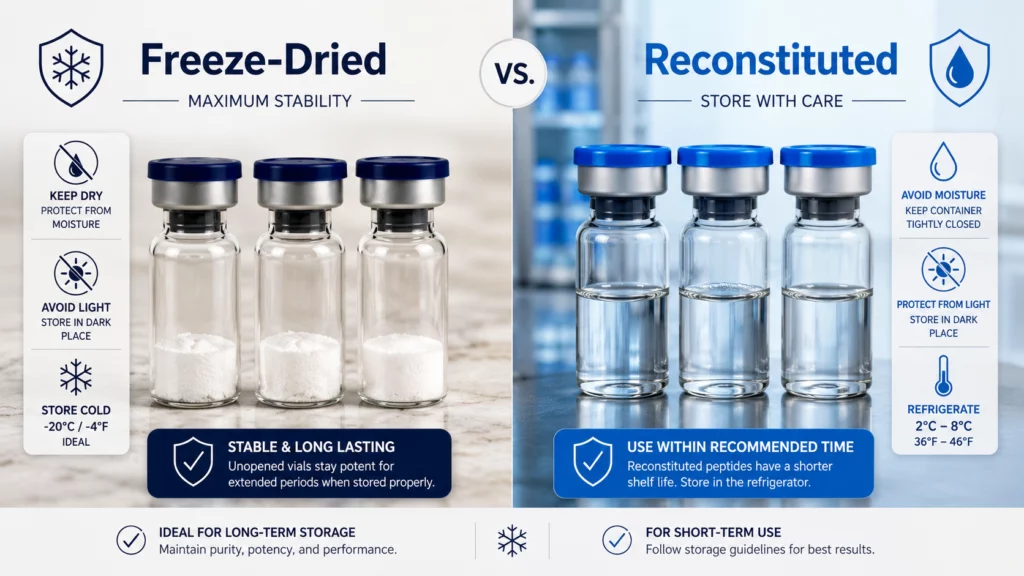
Freeze-dried peptides are dry. Reconstituted peptides are in solution.
That difference changes the way each form is stored and handled in a research setting.
Freeze-Dried Peptides
Freeze-dried peptides are also called lyophilised peptides.
They are usually supplied as dry powder in a vial. This form is often preferred for research supply because dry peptides are generally easier to store before reconstitution.
However, freeze-dried peptides still need careful storage. Heat, light, air, and moisture can all affect peptide stability.
Reconstituted Peptides
Reconstituted peptides are peptides that have been dissolved into a suitable research solvent.
Once the peptide is in solution, storage becomes more sensitive. Peptide solutions are usually less stable than dry powders and may be affected more quickly by time, contamination risk, and repeated temperature changes.
That is why reconstituted peptide storage is best understood as a separate stage from storing a sealed dry vial.
Why Lyophilised Peptides Are Usually More Stable
Lyophilised peptide powder has had much of its water removed.
That matters because water can support chemical changes and reduce long-term stability in some peptide materials.
A dry vial is not stable forever, but it is usually the more stable form before reconstitution.
This is why many research products are supplied as lyophilised powder, including 5-Amino-1MQ 10mg, MOTS-c 40mg, Selank 10mg, Semax 10mg, Ipamorelin 10mg, and Tesamorelin 10mg.
Storage conditions still vary by product, peptide sequence, formulation, and research material type.
How Moisture Affects Freeze-Dried Peptides
Moisture is one of the main risks for freeze-dried peptides.
A cold vial can attract condensation when it is exposed to warmer air. If that moisture reaches the dry powder, it can reduce stability and affect the material over time.
For research storage, dry handling matters.
Temperature and moisture are separate concerns. A vial can be stored cold but still be affected by moisture if condensation enters the vial.
Freeze-dried peptide storage usually focuses on sealed containers, dry conditions, reduced light exposure, and controlled temperature.
How Reconstituted Peptides Change Storage Needs
Reconstituted peptides are usually more sensitive than freeze-dried peptide powder.
Once a peptide is in solution, storage depends on the peptide, solvent, concentration, pH, vial material, handling conditions, and research timeline.
Polygon Peptides lists BAC Water 10ml as a research reconstitution supply for diluting or dissolving lyophilised compounds in research settings.
However, all reconstituted peptides should not be treated the same.
Different peptides and blends can have different stability concerns. A single peptide such as GHK-Cu 100mg is not the same storage case as a multi-peptide blend such as GLOW 70, KLOW 80, or Wolverine Blend 20mg.
The product type matters. The storage state matters too.
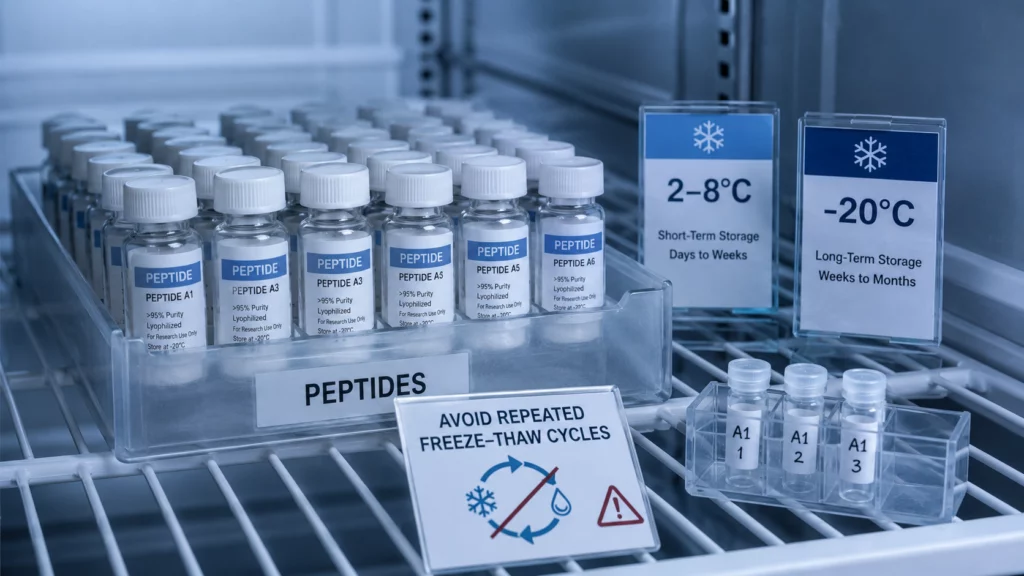 Peptide Storage Temperature: Room Temperature, Fridge, or Freezer?
Peptide storage temperature depends on whether the peptide is freeze-dried or reconstituted.
Room Temperature Storage
Some lyophilised research peptides may remain stable at ambient temperature before reconstitution when protected from direct light and moisture.
However, room temperature is not a universal storage condition for every peptide.
Peptide sequence, material form, container, and supplier storage notes can all affect the right storage approach.
Refrigerated Storage
Refrigerated storage is commonly associated with reconstituted peptide solutions in research contexts.
Many peptide product pages separate unreconstituted storage from reconstituted storage. This distinction is useful because a dry vial and a peptide solution are not the same storage case.
Freezer Storage
Freezer storage may be used for longer-term laboratory storage of certain peptide materials.
However, repeated freezing and thawing can be harmful.
The issue is not only freezer temperature. The issue is repeated temperature cycling.
In research settings, aliquot planning can reduce repeated thawing of the same material.
Why Freeze-Thaw Cycles Matter
A freeze-thaw cycle happens when a material is frozen, thawed, and then frozen again.
Repeated freeze-thaw cycles can affect peptide integrity, especially in solution.
This is one of the most common peptide storage problems.
A research vial may experience freeze-thaw stress when the same vial is repeatedly removed from cold storage, allowed to warm, and returned to cold storage again.
For research work, this can create consistency problems.
Temperature stability is an important part of reliable storage.
Light Exposure and Peptide Stability
Light exposure can also affect storage quality.
Many peptide storage notes recommend protecting research materials from direct light. This matters in storage areas exposed to sunlight, bright bench lighting, or repeated open-shelf handling.
A dark, dry, controlled storage area is usually more suitable than a bright shelf or open workbench.
Light protection does not replace temperature control, but it supports better research handling.
Common Peptide Storage Mistakes
Treating Dry and Reconstituted Peptides the Same
Freeze-dried peptides and reconstituted peptides are different storage cases.
Dry powder is usually more stable. Solution storage is usually more sensitive.
Opening Cold Vials Too Quickly
Opening a cold vial too quickly can increase moisture risk.
Condensation can become a problem when cold material is exposed to warmer air.
Leaving Vials in Direct Light
Direct light creates unnecessary stability risk.
Peptide storage is better supported by dry, dark, and controlled conditions.
Repeatedly Freezing and Thawing the Same Vial
Repeated freeze-thaw cycles can affect peptide integrity.
This concern becomes especially important after reconstitution.
Ignoring Product Differences
Not every peptide behaves the same.
A single peptide, a copper peptide, an incretin research compound, and a peptide blend may all have different storage considerations.
Storage Notes Across Polygon Peptides Research Products
Polygon Peptides offers several research-use peptide products and blends. Across the range, the same storage question matters: is the material still freeze-dried, or has it already been reconstituted?
For individual peptide products, this peptide storage guide is relevant to research materials such as BPC 157 10mg, GHK-Cu 100mg, Ipamorelin 10mg, MOTS-c 40mg, MT2 10mg, Selank 10mg, Semax 10mg, and Tesamorelin 10mg.
For incretin and metabolic research compounds, the same freeze-dried vs reconstituted distinction also matters for Retatrutide 10mg, Semaglutide 10mg, and Tirzepatide 10mg.
For blends, storage can be even more important because more than one compound may be present in the same preparation. This applies to GLOW 70, KLOW 80, and Wolverine Blend 20mg.
For related research compounds, product-specific storage information still matters. This includes 5-Amino-1MQ 10mg.
The full range is available through the research peptides UK shop.
Where BAC Water and Calculators Fit Into Storage
Reconstitution changes the storage state of a peptide.
A dry peptide vial and a reconstituted peptide solution are different from a storage perspective.
Polygon Peptides provides BAC Water 10ml as a research supply for diluting or dissolving lyophilised compounds in research settings.
The site also includes a peptide calculator for research calculations.
These are research preparation and handling resources, not human-use guidance.
Freeze-Dried vs Reconstituted Peptides: Quick Comparison
| Storage Point | Freeze-Dried Peptides | Reconstituted Peptides |
|---|---|---|
| Physical form | Dry lyophilised powder | Peptide in solution |
| Main risk | Moisture, heat, light | Time, contamination, temperature swings |
| Stability | Usually more stable before reconstitution | Usually shorter storage window |
| Light exposure | Direct light is avoided | Direct light is avoided |
| Moisture issue | Very important | Contamination risk becomes more important |
| Freeze-thaw concern | Unnecessary cycles are avoided | Repeated cycles are especially problematic |
| Best storage idea | Dry, sealed, dark, controlled | Refrigerated handling and reduced temperature cycling |
 Research-Only Reminder
Polygon Peptides products are supplied strictly for laboratory and scientific research use.
They are not intended for human consumption, medical treatment, or veterinary use.
This peptide storage guide is only about research storage and handling principles.
It does not provide dosing, injection, treatment, or personal-use advice.
FAQs: What People Ask Google and AI Apps
What is the difference between freeze-dried and reconstituted peptides?
Freeze-dried peptides are dry lyophilised powders. Reconstituted peptides have been dissolved into solution. The solution form usually needs stricter storage and handling.
Do freeze-dried peptides need refrigeration?
Some freeze-dried peptides may remain stable at ambient temperature before reconstitution, depending on the product. However, storage conditions vary by material and product type.
How are reconstituted peptides stored in research settings?
Reconstituted peptides are usually more storage-sensitive than dry powder. Storage commonly focuses on refrigeration, reduced handling time, and avoiding repeated freeze-thaw cycles.
Why are peptide vials protected from moisture?
Moisture can reduce the long-term stability of solid peptide material. This is especially important for freeze-dried peptide powder.
Can repeated freeze-thaw cycles affect peptide stability?
Yes. Repeated freeze-thaw cycles can affect peptide integrity, especially for peptide solutions.
Why are lyophilised peptides often supplied for research?
Lyophilised powder is commonly used because dry peptide material is generally more stable before reconstitution than peptide solution.
Why does product-specific storage matter?
Different peptides, blends, solvents, and storage states can create different stability concerns. A freeze-dried vial and a reconstituted solution are not the same storage case.
Final Thoughts
Freeze-dried and reconstituted peptides are different storage cases.
Freeze-dried peptides are usually the more stable form, but they still need protection from moisture, light, and unnecessary heat.
Reconstituted peptides need stricter handling because solution storage introduces new stability and contamination concerns.
Reliable peptide storage depends on storage state, temperature control, moisture protection, light exposure, and reduced freeze-thaw stress.
For research buyers comparing Polygon Peptides products, the key question is not only which peptide is being studied. It is also whether the material is still lyophilised or already reconstituted.
Sources
Last Updated
June 10, 2026