Introduction
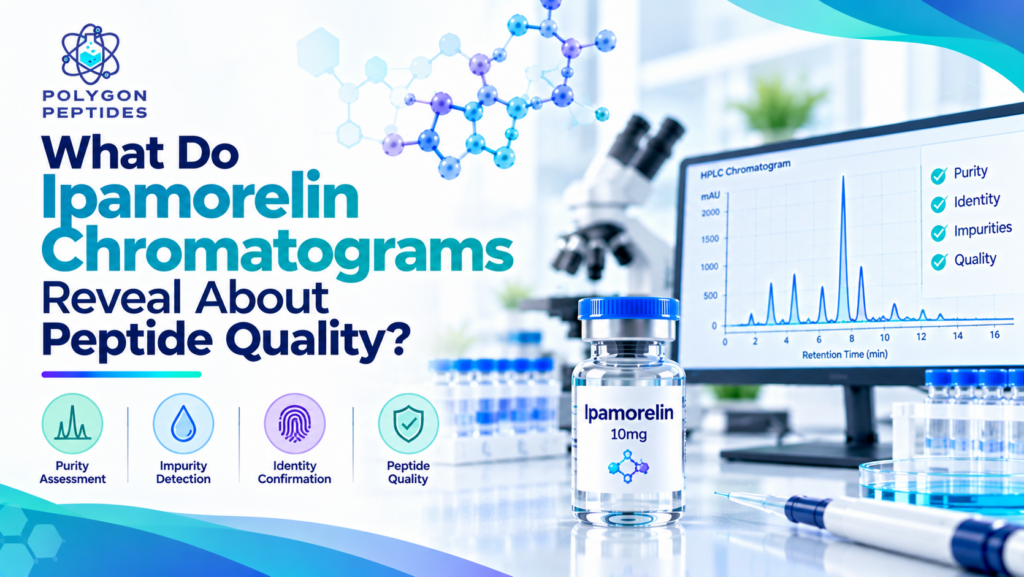
Peptide quality analysis does not only rely on visual inspection or use of one purity value of the substance in question. Analytical methods provide more detailed ways of sample examination that allow identification of possible inconsistencies and limitations of a particular method of testing. In such a context, it could be quite informative for the analyst to learn more about the Ipamorelin chromatograms.
This gives the possibility to study peaks, retention behavior, and other distinctions between samples. However, interpretation of these plots requires scientific judgment.
The analytical meaning of the term Ipamorelin peptide quality includes differentiation between apparent purity obtained by chromatography and the real molecular structure of a sample, along with other quality parameters.
Understanding the Role of Chromatography in Ipamorelin Analysis
Ipamorelin Chromatographic Analysis is an application of known separation principles to a certain sample of peptides. One of the methods of separation that may be employed here is high-performance liquid chromatography (HPLC), during which components of the sample flow into a column under certain conditions.
Depending on how the sample components interact with the column’s stationary phase and the mobile phase as they pass through the column, they may separate because they elute at different times, appearing as peaks registered by the detector.
The reversed phase of chromatography can be used in peptide separation since it can discriminate compounds on the basis of different chromatographic behaviour of those. Other methods may be employed if the problem to be answered analytically requires consideration of such properties of the compound as molecular size or charge.
Choice of the method is important, as any method of separation does not discriminate all possible components equally effectively.
What Do the Peaks in Ipamorelin Chromatograms Represent?
The peaks observed on the graph represent responses generated by the passage of detectable substance into the detection system. Analysis of these aspects would provide useful insight regarding the separation process.
The Retention time in peptide chromatography refers to the time needed for the sample substance to reach the detector based on certain criteria. It is useful for comparing samples analyzed using the same technique, but retention times are not enough to prove the chemical identity of a compound. Different substances may exhibit similar retention behavior under certain conditions.
Chromatographic peak interpretation requires full analysis of the chromatogram, including the baseline, peak resolution, and other analytical parameters. Analysis of one prominent peak without considering other peaks around it may miss useful data.
Can HPLC Results Reliably Indicate Ipamorelin Purity?
“Ipamorelin HPLC analysis” can be used to demonstrate the purity of the chromatogram if the method is appropriate for its intended purpose. Scientists tend to analyze the relative areas of the peaks in order to find out how the signal is distributed within the chromatogram.
The simple calculation of area normalization includes dividing the area of a single peak by the total area of all the peaks and multiplying the result by 100. Thus, the percentage will show what portion of the peak contributes to the overall chromatographic signal.
These restrictions are important while analyzing Ipamorelin purity. For example, the presence of a single dominant peak can be seen as the presence of the major component; however, it cannot exclude other substances that are not detected and overlap the signal.
Ipamorelin sample purity analysis is possible only if there is proper method development, control, and proof of the possibility of separation of the components. According to the ICH Q2(R2), the validation of the analytical procedure should be done according to its intended purpose,e taking into account such parameters as specificity, accuracy,cy and precision.
Identifying Potential Impurities Through Chromatographic Analysis
Ipamorelin impurity profiling includes analysis of data related to impurities in addition to the target compound. An additional peak might give insight into the sample composition, especially when the peak is reproducible and the technique used can separate the components in question.
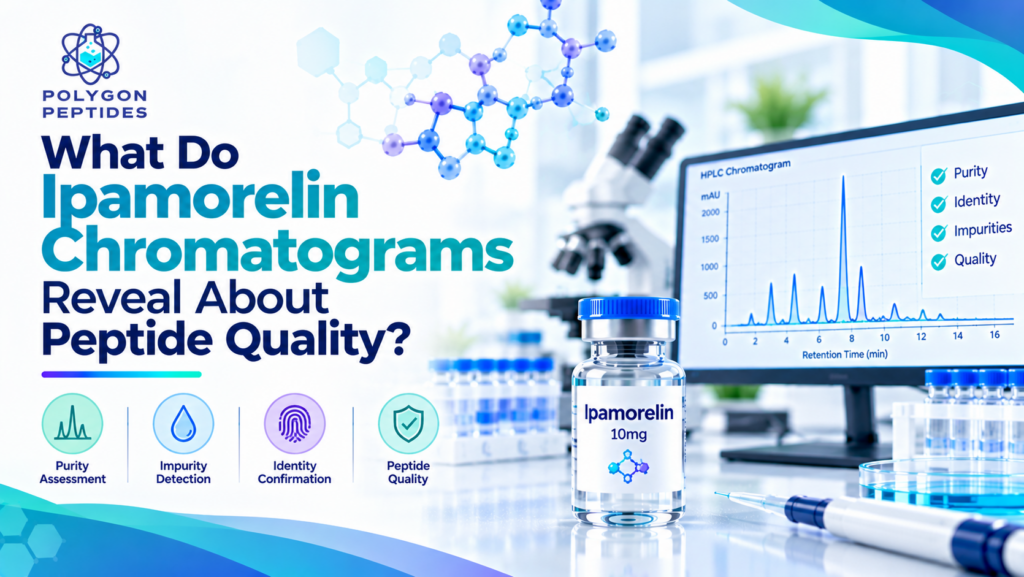
An additional peak is, however, not always proof of contamination since it might relate to an impurity, degradation product, sample component, solvent peak, or analytical system artifact. Controls and further analyses are required to sort these out.
Likewise, the absence of an additional visible peak does not necessarily mean that all impurities have been detected. Certain impurities can be below the detection limit of the analysis technique used or overlap with the principal compound.
In the process of identifying impurities in peptide samples, unexpected signals can be investigated using supplementary techniques such as mass spectrometry.
Ipamorelin impurity profiling does not entail counting the number of peaks but rather entails understanding what the available data indicate, what is unclear, and whether more analysis is required.
Factors That Influence Ipamorelin Chromatographic Results
There are several factors that can influence chromatographic behavior, which means that the difference between the results does not necessarily imply a difference in the quality of the samples.
Sample preparation is one such factor. Inconsistency in preparation, inappropriate concentration, or contamination with particulates can affect the results and might damage the analytical system. It is important for researchers to document their sample preparation techniques and evaluate whether they might cause any variability.
Another factor that can influence the results is the “mobile phase.” The properties of the mobile phase, such as its composition and pH level,l can have an effect on the interaction between the sample and stationary phase. These are some of the factors affecting Ipamorelin purity.
Why Are Mass Spectrometry and Reference Standards Important?
Chromatography offers information about the separation process; however, further analytical evidence may be required in order to substantiate the identification of a certain compound. Mass spectrometry for peptide analysis involves ions being measured according to their mass-to-charge ratios, thus providing information regarding whether the observed component fits into the predicted molecular mass.
Mass spectrometry, when combined with the technique of liquid chromatography, may be used to link the mass data with the results of chromatography. This combination can assist in studying those components which cannot be reliably identified through retention time only.
Another source of comparison includes peptide reference standards. Having a well-defined reference standard may allow researchers to analyse the expected behavior of their analytical method.
Combining information from chromatography, mass spectrometry, and adequate reference materials may enhance the peptide quality assessment process.
How Can Researchers Enhance the Accuracy of Ipamorelin Purity Determination?
An analytical conclusion can be reliably drawn based on a well-understood goal of measuring the specific technique. Scientists should establish the purpose of analysis in terms of identification, impurity detection, purity assessment, or other kinds of processes before selecting any method.
Method validation of analytical methods assists in proving that the specific technique is adequate for its purpose. For a particular purpose, there could be parameters such as specificity, accuracy, precision, detectability, and robustness. But the choice of validation experiments is not the same for all procedures – their purpose should be taken into account.
The use of proper control experiments and system suitability allows for additional information.
A clear report also plays a crucial role. In particular, the results should be clearly stated as measurements versus interpretation. It is incorrect to state the percentage as definite evidence of quality when the method cannot do so. Such principles make possible the reproducibility of peptide testing results.
What Chromatograms Cannot Tell Researchers on Their Own?
There are three main limitations of chromatographic purity testing: incomplete separation, different detector responses, and the chance that some compounds will not be revealed at all. The analysis can also depend on the specificity of the approach and the quality of the supporting results.
A chromatogram cannot confirm the biological activity based on the presence of a certain retention time alone. Furthermore, being apparently pure does not mean that something is necessarily safe and appropriate for human application either.
Speaking of Ipamorelin peptide quality, one must distinguish between analytical results and the general quality. Results have to be considered in the context of the procedure they were obtained by.
Researchers working with data from any suppliers, labs, or other educational resources, including Polygon Peptides, must know about the supporting documents and the validity of conclusions based on the specific results.
Conclusion:
Ipamorelin chromatograms contain valuable data on the process of chromatographic separation, peak shapes, and the distribution of peaks. If there is proper methodological support, the above facts may help in investigating impurities and the purity level of the substance.
However, it is important to note that a high peak does not necessarily mean that something is absolutely pure; neither does a peak on its own imply that a substance has been contaminated.
The combination of the results of chromatography with other analytical techniques can help to draw more reliable conclusions about the composition of the sample. In general, Ipamorelin purity analysis relies on validated methods and proper conclusions.
References and scientific sources
- 1. Council for International Harmonization (ICH).
- FDA. Q2(R2): Validation of Analytical Procedures.
- Analysis of Peptides by HPLC and Purification. Scientific review covering HPLC separation modes and peptide analysis.
- Council for International Harmonization (ICH).