
Introduction
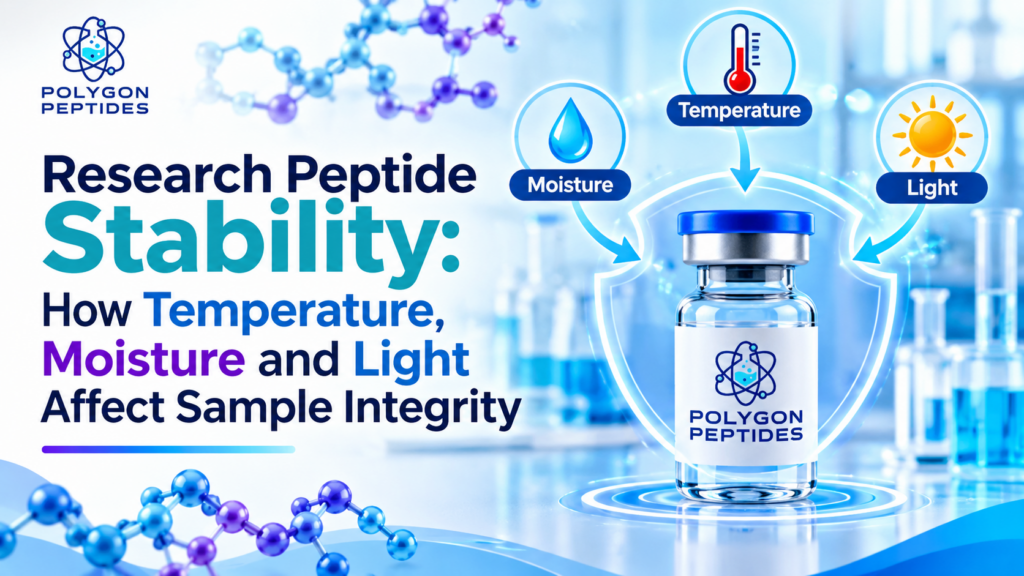
Due to the variety of their chemical structures and possible use in scientific research, peptides are widely studied in the laboratory. It might not be easy for them to remain structurally intact while being analyzed, handled and stored in the laboratory. They may undergo various kinds of physical and chemical changes due to certain environmental factors like moisture, light and temperature.
Therefore, the stability of peptides is an aspect of research quality control that is important to know. Oxidation, hydrolysis, aggregation, and other types of degradation can occur as a result of changes in environmental conditions, which may impact the analytical results and sample consistency.
Understanding the stability of research peptides, understanding the degradation process and evaluating the stability of a research sample will result in better research results in the lab setting using synthetic peptides.
The paper considers the important aspects of the factors that affect peptide stability and degradation processes as well as the ways of analysis to evaluate the peptide.
Looking for practical handling steps? See our peptide storage guide for freeze-dried and reconstituted vials.
What Is Peptide Stability?
Stability of peptides is the ability of a peptide to retain its physical and chemical properties for some period of time.
Peptides are chains of amino acids bonded together by peptide bond. These molecules are well characterized in terms of their chemical structure but can be unstable due to their sequence of amino acid residues, properties, and environment.
Peptide chemical stability is affected by several factors such as:
Environmental temperature and conditions.
- Exposure to moisture and humidity.
- Exposure to light and air.
- Solvent composition and pH.
- Sequences and structure of amino acids.
- Interactions with container materials and surrounding materials.
There are two types of stability: chemical stability and physical stability. Chemical stability relates to changes in molecular composition, and physical stability to physical properties such as aggregation, precipitation, and changes in solubility.
To evaluate peptide sample integrity and to interpret laboratory results, it is important to understand both aspects.
Factors That Affect Research Peptide Stability
The stability of synthetic peptides may change depending on the environment and the chemical factors. Peptides do NOT react in the same way because the amino acid sequences and their structures are all different.
These are some of the key factors in laboratory research.
1. Temperature and Peptide Stability
Peptide stability testing can be performed on peptides for various reasons, among which the investigation of environmental factors such as temperature.
The rate of a chemical reaction can be changed by a change in temperature, which in turn will affect the movement of molecules. If the temperature rises, there could be instances where the degradation processes could happen even faster, such as oxidation and hydrolysis, among others, depending on the conditions.
Some peptide formulations can also change their physical characteristics as a result of temperature changes. For instance, changes in molecular interactions may lead to aggregation or a decrease in solubility.
But different sequences of peptides are very different when it comes to temperature. The effect on one peptide could be different than another.
This is why it is important to take into account the temperature when assessing the stability of peptides under various conditions and not take it for granted that all peptides will behave in the same manner.
2. Exposures to moisture and humidity
Another aspect to look at when studying the stability of lyophilised peptides is moisture.
Lyophilisation or freeze-drying is a process which involves the removal of water from a material. It provides a dry formulation which may provide better physical and/or chemical stability than some liquid formulations.
But moisture in the surrounding environment can react with the freeze-dried material.
Molecule mobility may also be influenced by the presence of water, which could lead to the occurrence of some degradation processes. Hydrolysis and aggregation and other chemical changes may be facilitated by the presence of moisture, depending on the peptide formulation.
This means that during laboratory quality assessment, it is important to consider peptide moisture sensitivity.
The moisture-related factors are thus examined when analysing the stability properties of lyophilised materials.
3. Light Exposure and Oxidation
Some peptide sequences may undergo chemical changes under the action of light.
A certain number of amino acid residues are especially sensitive to oxidation or photochemical reactions. Under specific conditions, the chemical changes of tryptophan, tyrosine, and other light-sensitive components can occur.
The molecular structure of a peptide is also likely to be altered by oxidation, and thus the analytical properties of the peptide may also be altered.
This relationship between peptide oxidation and light exposure is especially pertinent when studying peptides which contain oxidation-prone amino acids.
When studying peptide degradation and sample quality, other environmental factors are taken into account, in addition to light exposure.
4. The pH and Chemical Environment.
Peptide stability may also be influenced by the chemical environment.
pH levels can influence the charge of the amino acid residues as well as molecular interactions and reactions of the peptides.
Some conditions may promote the possibility of hydrolysis, deamidation or other chemical changes.
For instance, asparagine and glutamine can deamidate, as can other amino acids, and they are also subject to oxidation.
Therefore, only temperature and moisture alone cannot be used to assess the chemical stability of peptides. A chemical environment should also be taken into account when conducting investigations in the lab.
What Is Peptide Degradation?
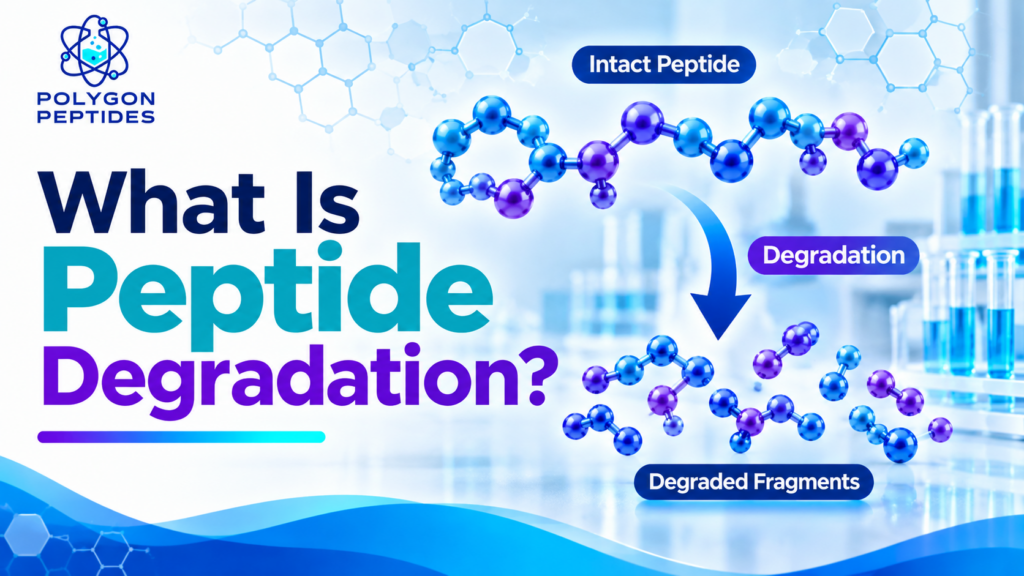
Degradation of peptides occurs when chemical or physical changes occur to the peptide’s original structure or characteristics.
These changes can happen during manufacturing, processing, shipping, or lab testing, or storage.
Common degradation processes need to be recognised because degradation processes can yield different results from the analysis.
Some common pathways of degradation that are investigated are listed below.
Oxidation
Oxidation reactions are those that change the amino acid residues that are susceptible.
Some amino acids can oxidize under certain environmental conditions, such as Methionine, cysteine,and tryptophan.
These changes may cause changes in molecular composition and may be responsible for changes in peptide characteristics.
Deamidation
Peptide deamidation: Chemical reaction in which asparagine or glutamine residues are transformed to their acidic counterparts.
This process can change the charge of a peptide on the molecular level and other properties.
It occurs under certain conditions including amino acid sequence, pH and environmental conditions.
Hydrolysis
The word hydrolysis is used to describe the process through which the substance will chemically react with water, leading to the breaking of the chemical bonds. There are times when hydrolysis can occur in the peptide bonds or other hydrolysable bonds.
The degree of this process will be dependent on the structure of the peptide and the chemical conditions.
Aggregation
The process of grouping of peptides to form molecular aggregates is known as peptide aggregation.
Aggregation can affect the physical properties, such as sample uniformity and solubility.
It can also make it more difficult to analyze the material in the lab, as it can make it harder to determine how the material will react with the other molecules present.
It is important for researchers to be able to tell the difference between different modes of degradation in an analytical investigation, and the knowledge of these mechanisms will assist in such an investigation.
How Researchers Evaluate Peptide Stability
Aside from the appearance of a sample, there are several factors to consider when assessing the quality of a research peptide.
Analytical techniques are used by researchers to get an idea of the molecular composition, purity, and possible degradation products.
There are multiple approaches for peptide characterisation and quality assessment.
High Performance Liquid Chromatography (HPLC)
HPLC analysis is one method of separating the elements in the sample.
It may be useful as a reference peak to pick up the major peptide peak and differentiate it from some impurities or degradation products.
Changes in the composition of the samples can be assessed, and differences between batches can be investigated by using the chromatographic profile as a tool for the researchers.
The HPLC purity percentage is not necessarily a definitive indicator of identity, biological activity, or the overall quality of the product, however.
Mass Spectrometry (MS)
One of the methods which are used to study the molecular mass of peptide-related molecular components is mass spectrometry peptide analysis.
Can be used for molecular identification and for study of some chemical modifications.
Mass spectrometry can be used in conjunction with chromatographic techniques to obtain more information about the composition of samples.
Stability-Indicating Analytical Methods
Peptide stability testing can include analysis of peptides at a specific point in time, under specific conditions.
Changes can be explored by researchers:
- Molecular composition.
- Chromatographic peak profiles.
- Degradation product levels.
- Clumping and color.
- Solubility characteristics.
The method of analysis must be appropriate for the peptide and the specific degradation mechanism(s) under study.
Why Batch Documentation is crucial for Research Peptides?
Documentation in the laboratory is important, and part of laboratory quality assessment is batch documentation.
The analytical properties may vary from one batch to another, even if the sequence of peptides remains the same, owing to manufacturing.
Variations about the batch, including process, impurities, and other parameters.

Information about a particular batch along with the analyses performed on that batch may be provided in a COA of a peptide.
A COA can contain the following information, depending on the documentation from the supplier and the type of test:
- Product identification.
- Lot or Batch number.
- Reported purity.
- Analytical testing methods.
- Test results and specifications.
- Relevant quality information.
Researchers should be aware of what each of the results reported indicates and if the testing method is suitable for the claim being made.
For instance, HPLC purity is not sufficient to identify a peptide or its stability over time.
Thus, peptide batch consistency evaluation should take into account the analytical documentation, testing methods, and available limitations of analytical results.
Transparency around documentation enables research suppliers to educate their customers about the data on a single batch.
Conclusion
Laboratory research and peptide quality analysis need to consider stability of peptides. There are various factors that can affect peptides including properties of temperature, humidity, light and chemistry, and the modes of degradation such as oxidation, hydrolysis, deamidation, and aggregation among others can result to sample degradation.
This can be analyzed through analytical procedures such as HPLC and mass spectrometry.
It is also important to consider batch-specific testing, analytical techniques and the limitations of purity results reported, when coming to the reliability of research documentation.
Customers who buy research peptides should understand how stability affects results. At Polygon Peptides, research quality is a priority, and understanding peptide stability helps when assessing the analytical properties of materials used in the lab.
FREQUENTLY ASKED QUESTIONS
The stability of peptides can be affected by their temperature, moisture, light, pH, and exposure to oxygen, as well as their amino acid composition. These effects can be different depending on the peptides and the formulation.
Lyophilized stability of the peptide refers to the property of lyophilized formulation of the peptide to maintain physical and chemical characteristics for some period of time. It may be affected by such elements as conditions and moisture.
Generally, it is assumed that peptides undergo oxidation, hydrolysis, deamination or aggregation.
"Peptide HPLC" means that there is a process for the separation of the components of the sample. Mass Spectrometry can be applied for further information about the nature and modifications of the molecules.
Peptide stability testing is useful in discovering how the makeup of the sample changes, in the process of studying possible degradation products and in the verification of the analytical consistency.