
Introduction
As scientific communities discuss the peptide, it is evident that it has become a popular subject of research in laboratories and in biotechnological and molecular studies. As interest grows, the factors determining the quality, purity, and reliability of peptide products are receiving increasing attention. From an educational and scientific perspective, it is important to understand these factors when researching the best research peptides uk market.
The peptide industry has developed quite a bit in the last decade. With the emergence of new technologies associated with manufacturing, testing, and quality standards, researchers and laboratories have become able to acquire highly characterized peptide products. From studies on genetic research peptides uk trends to laboratory-grade compounds, quality is the most significant factor to consider.
In the following article, we will analyze thirteen main characteristics of peptides and the importance of such characteristics for current scientific research.

Understanding What Research Peptides Are
To comply with quality standards, first of all, one should consider the basic question: what is a research peptide?
A peptide is a short chain of amino acids, which is primarily applied for research purposes and thus referred to as research peptides. They are examined under lab conditions in order to collect information on biological processes, signaling, and protein-protein interaction. Research peptides are commonly used in biochemistry, pharmacology, genetics, and molecular biology.
It is crucial to control peptides precisely in order to obtain accurate research results as peptides affect biological systems.
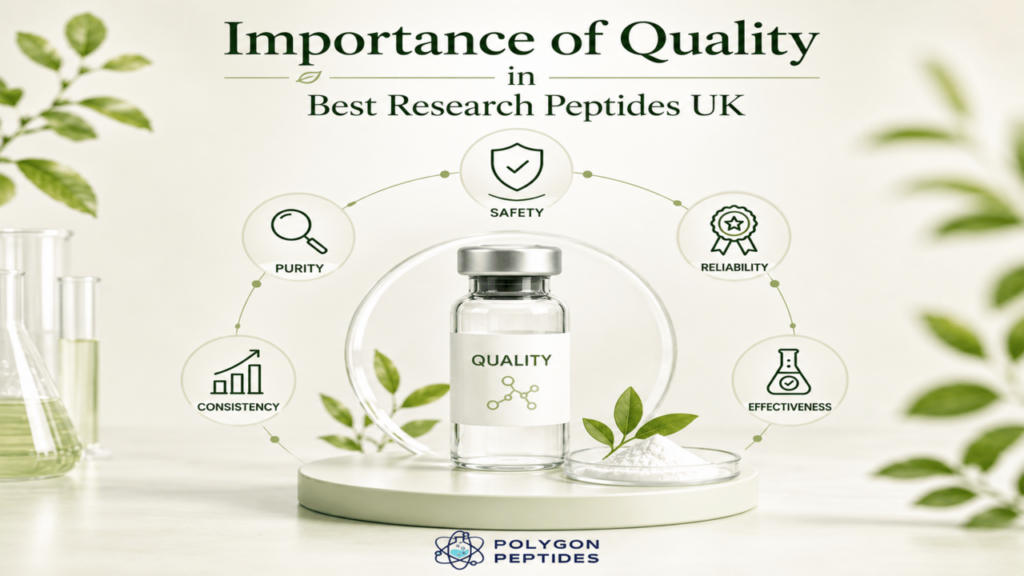
Importance of Quality in Best Research Peptides UK
best research peptides uk refers to peptides that have high purity, consistency, testing, and documentation standards. Quality has a direct influence on research results since impurities or inconsistencies can lead to inaccurate results of the experiments.
Several parameters are usually involved in the selection of peptide materials for research or laboratory use. These factors make it possible for the compounds to behave according to expectation in the lab.
1. High Purity Levels
One of the main quality markers of a peptide is purity. A high-quality peptide will have undergone a much more thorough purification process to ensure that it is free from contaminants and unwanted byproducts.
The purer the peptide, the more predictable the outcomes are because it becomes easier for the scientists to ensure that the outcome is from the peptide and not from some other factor.
Purity can be ensured through the use of some advanced analytical techniques like high-performance liquid chromatography (HPLC).
2. Accurate Amino Acid Sequencing
Even the slightest mistakes in sequencing may significantly alter the characteristics and efficiency of the substance.
An accurate production process ensures a correct peptide sequence. In a field like genetic research peptides uk, where molecular precision is crucial, accurate sequencing is particularly important.
3. Comprehensive Laboratory Testing
Before distributing peptides for research use, the peptides should be carefully analyzed in a laboratory.
Common testing procedures are:
HPLC analysis
Mass spectrometry
Identity verification
Purity assessment
Stability testing
Extensive testing ensures peptides are of research quality.
4. Consistency in Manufacturing Standards
Reproducibility is vital in science. Researchers must be assured that all their peptide preparations are performing the same way in the same experimental conditions.
Manufacturers with good batch consistency tend to have their production process well-controlled. This uniformity aids long-term research projects and comparative studies.

5. Reliable Documentation
Generally, good materials on peptides are well documented.
Researchers often review:
Certificates of analysis
Purity reports
Batch information
Storage recommendations
Analytical test results
Documentation enhances transparency and fosters scientific integrity.
6. Advanced Synthesis Technology
The production quality has improved significantly with the modern peptide synthesis technique.
Highly sophisticated equipment and controlled manufacturing environments are used in the synthesis to minimise the possibility of errors. This technological development helps to develop peptide compounds with greater accuracy and reliability.
The future of molecular research is being continuously influenced by the development of peptide synthesis techniques.
7. Proper Storage Conditions
If improperly stored, even highly pure peptides are prone to degradation.
A quality-focused laboratory perceives that:
Temperature control
Moisture protection
Light protection
Appropriate packaging
The peptide can be safeguarded against degradation during research with correct storage.
Such an aspect is very important for the products which come in tirzepatide peptide vial uk and other custom research peptides.
8. Closure, packing, and labelling.
Packaging is an integral part of the quality preservation of peptides.
Some of the properties normally analyzed include:
Tamper Evident Seals
Sterile containers
Accurate labeling
Batch identification numbers
Peptide vial labels uk are clear and professional, assisting researchers in identifying products properly and keeping precise laboratory records.
9. Stability and Shelf Life
The stability of peptides impacts their long-term use.
Stability studies are performed on high-quality products to assess their stability over time under given storage conditions. Long-term studies can be carried out with greater confidence when using stable peptides.
Knowing the shelf-life recommendations can reduce waste and ensure uniformity of the experimental conditions in the laboratory.

10. Research Laboratory Standards
Some researchers assess the standards that research labs uk peptides providers, and manufacturers adhere to.
Organizations that are dedicated to scientific quality often use:
Standard operating procedures
Quality assurance systems
Controlled production environments
Independent testing practices
High-quality laboratory standards help to ensure more trustworthy research materials.
11. Transparency in Research Use
Transparency in education and sciences is also one of its features.
Professional groups make it clear what research applications they are intending and deliver technical information that is relevant. There is a positive link between transparent communication and responsible science, and between transparent communication and informed decision-making for scientists.
In the case of research chemicals for sale, transparency also plays an important role in discussing peptide research chemicals.
12. Customer Relationship Management (CRM)
Many researchers have the question: Are peptides legal in uk?
The answer will vary depending on the peptide, its application and regulations. There may be varying legal and regulatory requirements for varying types of compounds.
Quality organisations are aware of the latest guidelines and remain conformant to the relevant standards. Ethical use of research materials is promoted by having regulatory awareness.
Regulations should always be checked before performing any study in which peptide compounds are involved.
13. Scientific Reputation and Industry Recognition
Hailing from a brand with a long history of quality.
Regularly supplying dependable research materials helps to receive recognition within scientific circles. A positive response from researchers and institutions could be a sign of good quality management.
A good reputation is generally established by:
Consistent product quality
Reliable analytical testing
Accurate documentation
Scientific transparency
Professional customer support
The rising popularity of research chemicals.
Peptides are often confused with Research chemicals uk buy, legal research chemicals uk, research chemicals online uk and research chemicals for sale uk. These are all important topics and should not detract from the quality evaluation.
Researchers should focus on scientific standards, documentation, and analytical verification, rather than marketing claims. Experimental results are better ensured to be accurate and reproducible by using quality assessment.
Peptides and Modern Skin Research.
Peptides are also extensively researched in cosmetics and the dermatological field.
Peptides are often studied based on their interactions with the skin, and questions like what moisturizer has the most peptides or what types of peptides are for skin come up.
Below are some of the factors analyzed in the research process regarding skin-based applications:
Signal peptides
Carrier peptides
Peptide neurotransmitters
Peptide enzyme inhibitors
These are still hot topics in cosmetic science and dermatological research.
Understanding Peptide Compounds
It is not uncommon to find peptide compounds for sale online, but scientists should pay attention to the scientific description, not the promotional statement.
Some of the key points in the evaluation are:
Purity levels
Analytical testing
Manufacturing quality
Stability data
Documentation accuracy
Responsible scientific research is made possible by careful consideration of these factors.

Analytical Verification’s Role in the Enhancement of Peptide Research.
One aspect of peptide quality that is often ignored is analytical verification. For researchers, having verified data is essential to verify that a peptide is as specified. Modern laboratories today use advanced techniques for the determination of the molecular weight, purity, and structural integrity of a peptide before it is used in research.
When scientists are using resources to buy research peptides online uk for educational research, analytical verification is always a key parameter to take into account when gauging research-grade peptides. Verified testing data helps to minimise uncertainty and increase confidence in the results of experiments. With the advancement of peptide science, analytical verification remains a crucial part of ensuring high scientific standards.
Traceability in Research Materials is a very important aspect.
Through traceability, the scientists are able to monitor how the peptide moves from the process of creation to the point of application in the laboratory. It is possible that having complete batches will provide transparency in the process of research.
High-quality research lab peptides uk also have stringent traceability systems that record the manufacturing dates, testing methods, storage conditions, and analytical results. These records help in scientific responsibilities and allow for easier investigation of potential inconsistencies in research.
Traceability may prove to be particularly beneficial in long research projects where researchers can refer to their collected data over a period of time.
Emerging Trends in Genetic Research.
As scientists delve deeper into the peptide-cellular communication pathway relationship, the field of genetic research peptides uk is continually evolving. The interaction of peptides and their effects on gene expression, protein biosynthesis, and biological signaling pathways is being studied more often.
In recent years, with the progress of molecular biology, the potential opportunities for peptide studies have increased, and highly characterised research materials are in increasing demand. With the acquisition of new information, the quality of peptides becomes even more important since even slight changes in the peptide structure may affect the research outcome.
Clearly, these developments highlight the significance of purity, consistency, and analytical accuracy of peptide materials selection for laboratories
Future trends in the area of Peptide Research.
In light of the continuing development of biotechnology, the future of peptide research is looking bright with possibilities for scientific exploration. Pioneering applications in molecular biology, cellular research,, and protein engineering are being investigated. These advancements will likely continue to increase awareness and significance of research peptides and their potential applications in contemporary scientific research.
As synthesis technologies, analysis, and quality assurance systems improve continually, the standards linked to the most useful research peptides uk will doubtless become much stricter. Those who understand these changing quality standards will be well prepared to conduct scientific research that is both valid and accurate.

Conclusion
The field of peptide research is constantly expanding, with researchers investigating novel applications in molecular biology, biotechnology, genetics, and biochemical studies. It is crucial to define the quality to be able to assess peptide materials well.
The following thirteen characteristics (purity, testing, standards of manufacture, documentation, storage, stability, and transparency) give us an excellent ground for assessing peptide quality. From studying genetic research peptides uk to understanding laboratory standards, researchers can always benefit from a focus on science and reproducibility, especially when they analyze emerging peptide technologies.
In the end, searching for the best research peptides uk is more than just scouring product descriptions. Real quality is established through scientific testing, production uniformity, documentation, and a commitment to providing reliable scientific research.
FAQs
We hope we have answered all your questions regarding the best research peptides uk and their importance in scientific research.
1. What are research peptides?
Research peptides are small polypeptides used for scientific research purposes to study various biological functions, interactions of proteins, and other molecular mechanisms.
2. What makes purity of the peptide so important?
It is important to get pure enough peptide for the sake of reliable research results.
3. Are peptides legal in the UK?
The legality of the usage of peptides in the UK is dependent on the kind of peptide being used and its specific use. The researchers should first learn about the legal rules before conducting any research experiments.
4. How can peptide quality be evaluated via testing?
The main techniques employed for peptide testing include High Performance Liquid Chromatography (HPLC), mass spectrometry, identity testing, and stability testing.
5. What is the quality of research peptides determined by?
These are purity, correct sequencing, laboratory testing, manufacturing consistency, documentation, stability, suitable storage and transparency.