Introduction
As you’re looking to buy peptides uk, you’ll encounter a single comforting term time and time again on the research-product pages: “lab tested.” It seems a definite statement, like the big answers to the quality questions have already been given. In fact, the power of testing is only realized when researchers are knowledgeable about the thing tested, its analytical method, the results of the test, and whether the results are relevant to the material being evaluated. A testing claim should not close the discussion but open it up to the scientific evidence.
Quick Answer:
Don’t Ask “Was It Tested?” Ask “What Did the Test Show?”
Lab-tested is an action, not a result.
Researchers will find useful information after this phrase. Did the analysis attempt to look at purity, identity, etc.? Is there a report available? Is it possible to be added to the existing batch?
A useful testing story should enable researchers to go from the claim to the method, from the method to the result, and back to the specific material.
If that trail ends in the badge “tested,” then there are many unanswered questions.
A Laboratory Badge Is Not the Evidence
A product page with the microscope icon or a laboratory logo or the words “independently tested” will make it look like science. None of these individual elements of the report offers an analytical result by itself.
The best research peptides uk should therefore be isolated from the presentation.
A test sheet should be informative enough to give the reader enough background information to know how the test was analyzed and what information was derived from it. Labelling of the product is secondary to the supporting documentation.
The difference lies in the fact that marketing reports to researchers that a test occurred, and analytical records enable researchers to understand what occurred.
One Test Cannot Answer Every Quality Question
The key point to remember is that a single test can’t answer all quality questions.
There are various analytical questions associated with the characterization of peptides.
A method to determine purity does not necessarily give the same information as a method that can be used to support molecular identity.
The distinction is significant because several different quality questions may appear to be settled by a wide-ranging “lab tested” claim.
For research labs uk peptides can be incorporated into workflows where researchers want to be sure they have a reportable value.
Researchers should not only be concerned with the number of testing badges but their purpose as well.
That makes it a lot easier to discern what has and hasn’t been proven.
HPLC is More Than Three Letters on a Product Page
A common occurrence in researching peptide purity information is encountering high-performance liquid chromatography.
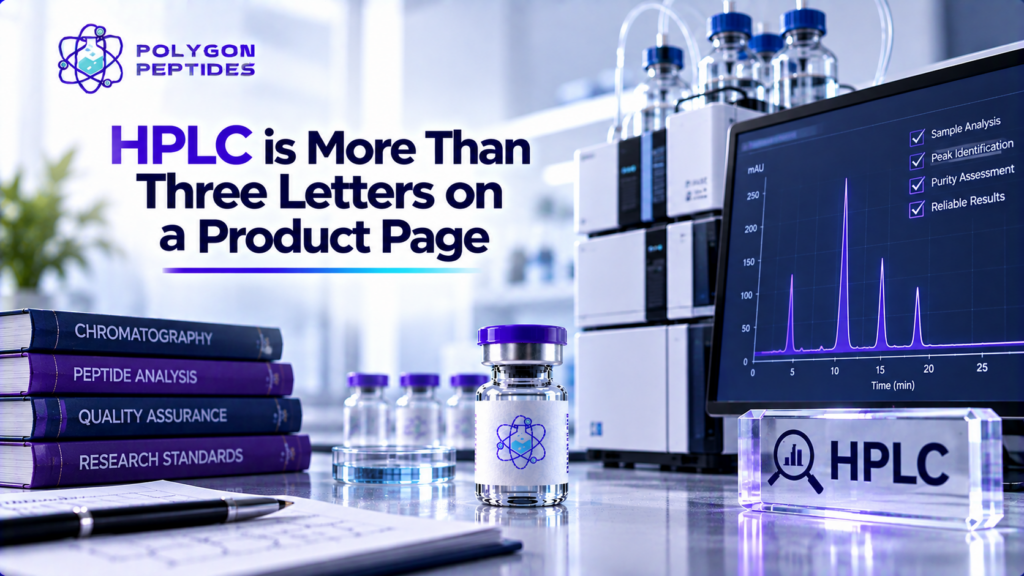
When looking for hplc peptide testing uk, individuals may encounter chromatograms or analytical details along with the purity percentages. Although HPLC can give evidence as to the composition and purity of the sample, the statement “HPLC tested” does not tell the whole story.
Researchers can search for the original analytical context and know if the information relates to the material or batch being evaluated.
A method name should generate data.
When that small link is missing, even technical jargon can be viewed as marketing.
The 99% Claim Still Needs an Explanation
One of the most easily marketed lab results is the purity percentage.
When scientists seek high-purity peptides for sale, it is natural to think that the three ratings of 98.8%, 99.1%, 99.6% have been obtained by using the same test. If the context for these ratings is different, then the comparison of them is inappropriate.
Researchers should ask about the method of obtaining the reported value and request the opportunity to examine supporting evidence.
A high percentage can be valuable information. It is not intended to be an exhaustive list of research quality.
The best number is the one that the researchers can set into context.
When it comes to identity evidence, it deserves its own place.
Suppose the result from an HPLC purity check on a product indicates high purity (higher than 98%). It may provide an answer to one important query, but scientists might require proof that links to the molecular identity.
One type of analytical technique that can supply information useful in molecular mass and identity is mass spectrometry.
Therefore, when looking at scientific research peptides for sale, researchers should not equate purity tested with identity confirmed.
There are tests that can be used in addition to one another.
A COA Should Translate Testing into something Readable
Researchers are usually looking for the testing information to converge in the Certificate of Analysis.
For readers asking what does coa stand for, it’s Certificate of Analysis. Most important of all, a helpfully constructed certificate should convey useful information about a material and the analytical results reported.
Researchers can inspect product identification, methods, specifications, batch/lot references, and reported values, if applicable.
If the COA merely states that the product was “passed” or “high purity” without providing any context, it is unlikely to answer any meaningful questions.
The certificate should be more easily understood than just another quality badge!
Batch-Specific Evidence Changes the Conversation
Assume a supplier has a good analytical report and has a past batch. Are all subsequent vials described automatically by that report?
Not necessarily.
The researcher may be required to keep records showing which materials have been used in which experiments in work related to genetic research peptides uk. A batch identifier assists in creating that connection.
The batch information on a vial can be compared to the identifier listed on its analytical documentation.
If, however, those details don’t match, the phrase “batch tested” turns into traceable.
If no relationship is evident, the researchers may require more data to make conclusions.
Independent Testing Sounds Good, but Read Further
“Third-party tested” or “independently tested” are attractive terms as they imply a dissociation of the supplier from the analytical laboratory.
The evidence should be investigated by researchers, however.
These are still the same questions to ask:
What material was tested? How were they accomplished? How did it turn out? Which batch did they test? Is the report able to be linked to the vial?
Therefore, locating a peptide shop uk that offers independent testing is only a first step.
A laboratory report is not an independent document and, therefore, cannot be understood without understanding the independence of the laboratory.
The Two “Lab Tested” Vials Can Tell Opposite Stories.
Let’s assume we have two vials of peptides that we are studying.
Notice the wording on the package of Vial A: “LAB TESTED — 99.7% PURE.” The website mentions testing on several occasions, but the analytical report is hard to link to the current batch. The method is only briefly referred to; there is little identity-related evidence, and supporting documentation adds little in terms of context.
According to Vial B, the purity is 98.9%. It’s much quieter marketing, but the batch number on the vial matches its COA. The purity result is accompanied by chromatographic information; there is relevant identity information, and the analytical documentation is presented clearly.
The more eye-catching headline is for Vial A.
Vial B provides researchers with more evidence to look at.
That comparison doesn’t make Vial B necessarily any better. It demonstrates why a quality conclusion of “lab tested” is not complete.
You’ve found the peptides online, but where will you get them?
Typically, researchers start their search with availability searches like where to buy peptides uk. Finding possible sources, however, is different from assessing the materials they present.
This is also true when researchers order peptides online.
Simply having digital availability doesn’t inherently show purity, identity, batch traceability, or documentation quality.
The evaluation should shift from the availability of a possible research material to evidence once it is identified.
After the search result is displayed, the following questions are important.
Similar Words Can Lead to Very Different Product Categories
The search term peptide is not necessarily synonymous with the term when used on the internet.
If you’re looking into types of peptides for skin, then you’re likely not looking for laboratory research materials, but cosmetic ingredients and consumer skin care.
Other searches may breach more sensitive lines. Information provided by Tirzepatide uk buy online could include both research materials and regulated medicines, not all of which should be considered equivalent.
Experimental Compounds Need Responsible Language
The same moderation applies to listings like buy bpc 157, which are experimental research products, and might be listed alongside health claims.
Test evidence shouldn’t be extended beyond its scope of evidence.
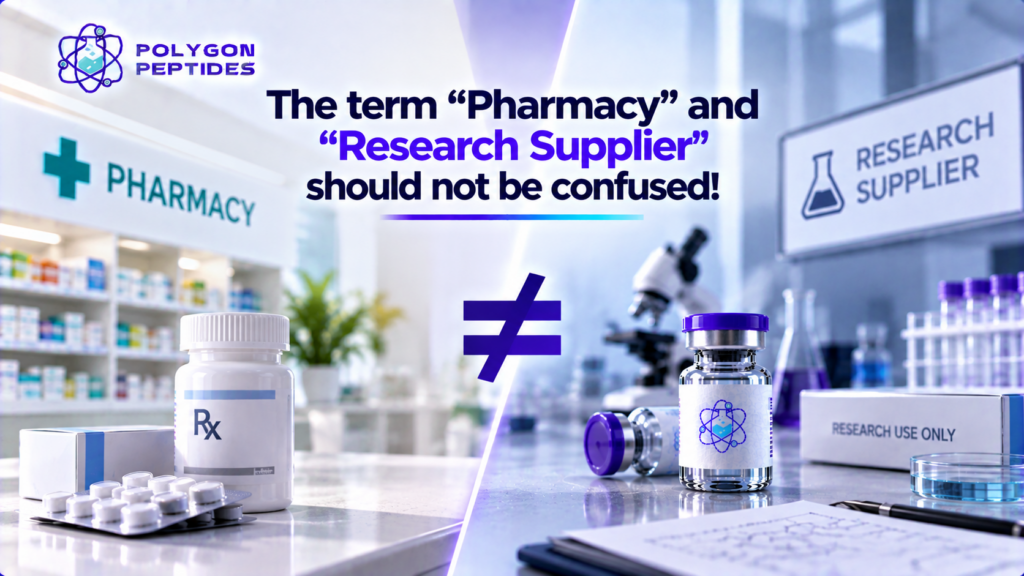
The term “Pharmacy” and “Research Supplier” should not be confused!
The term peptide compound pharmacy uk brings another pivotal difference to light.
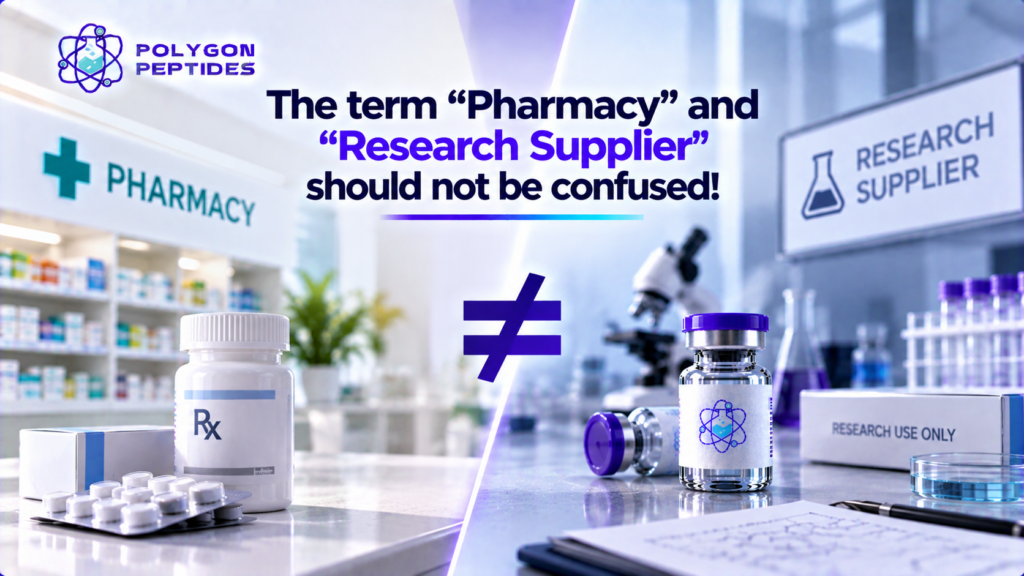
The term “regulated pharmacy/medicinal contexts” is not to be confused with suppliers providing materials for laboratory research. Discussions of peptides in both may not necessarily indicate the same regulatory environment or uses.
Read the Gaps as you would read the Claims
The appearance of “99% pure” on several pages without insight into the analysis should be addressed. When every batch tested is mentioned, and the batch relationship is not evident in the report, researchers have yet another question to ask.
Polygon Peptides does not take a scattershot approach to research documentation: we see it as a series of linked quality phrases.
Make better use of the word “Lab Tested”
If the researchers come across the phrase, they can think of five questions that they can ask:
- Which property was measured?
- Which analytical method was used?
- What answer did they get?
- Which batch is the result referring to?
- May the supporting documentation be seen?
The following questions (or the like) break down a broad statement into points that can be explored.
Also, they make comparisons more relevant as scholars are no longer comparing slogans. They are making comparisons about the evidence supporting them.
Final Thoughts
The phrase “Lab tested” can be helpful information if the testing story doesn’t end there.
The researcher needs to find the analytical procedure, know what the analytical procedure can tell the researcher, check the reported data, look at the COA, and decide if the evidence is linked to a relevant batch.
Sources and References
- Medicines and Healthcare products Regulatory Agency (MHRA) — UK data on medicines and investigational products, pharmaceutical quality and clinical research.
- Official guidance to medicines and clinical research in the UK from the Government of the UK.
- International Council on Harmonisation (ICH) — Scientific direction related to analytical procedures, validation, and the quality of pharmaceuticals.
- U.S. Food and Drug Administration (FDA) — Scientific and regulatory information on analytical quality and products related to peptides.
- Peer-reviewed scientific literature — Research on peptide characterization, chromatography, mass spectrometry research, analytical testing, and laboratory traceability.
Researchers should refer to existing primary scientific and regulatory guidance that is relevant to their research and institution for their particular material.
About the Author
The Editors of Polygon Peptides
The Polygon Peptides Editorial Team creates educational material on peptide research, analytical testing, documentation in the laboratory, and biotechnology. It has a clear editorial style, aiming to be as accessible to readers as possible to technical subjects while promoting evidence-based and responsible research practices.
The information in this article is only for educational and research use. Does not give medical, prescribing, or legal advice.
FREQUENTLY ASKED QUESTIONS
No. This expression does not indicate which was tested, what analytical technique was employed, what result was found, or whether the result applies to the present batch or not.
HPLC can give analytical information that can be related to the composition and purity of the sample. The findings of the research should be interpreted in the light of the method and material used.
Not automatically. Researchers should ensure that the certificate provides information on a specific batch or lot, and that the identifier matches the batch/lot of material they are testing.
Independent testing can provide an additional layer of separation from supplier to laboratory with additional value, but the method, results, sample identification, and batch relationship should still be examined by the researcher.
The analytical tests of a research material are not sufficient to establish medicinal authorization, clinical safety, effectiveness or suitability for human administration.