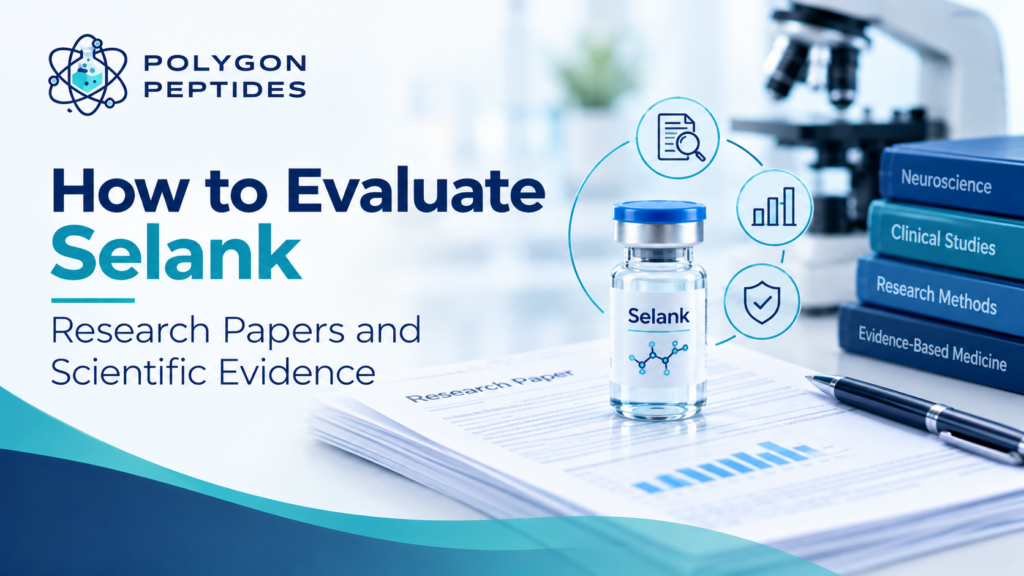
Introduction
Selank peptide research has become interesting due to a possible association with anxiety and stress reactions. Nevertheless, evaluating a scientific statement requires more than reviewing the research abstract or product description.
One needs to evaluate the study design, the group under analysis, and the methods of data collection used in the study, as well as supporting evidence in other independent research studies. This guide will help you evaluate research papers and scientific limitations.
Understanding Selank and Research Peptides
What Is Selank Peptide?
The selank peptide: what is it? is a typical research question. The Selank peptide is a synthesized heptapeptide, that means it consists of seven amino acids. The sequence of Selank is connected to tuftsin, a natural peptide sequence associated with immunity, with some extra amino acids added to its composition.
The use of Selank was studied by researchers in terms of effects on anxiety-related behavior, neurotransmitters, and other processes. A study from 2018 analyzed possible mechanisms connected with GABA receptors. Nonetheless, a biological mechanism does not guarantee clinical efficacy per se.
What Is Selank 10mg?
10 mg of Selank refers to Selank-like compounds that are claimed to have a concentration of 10 mg. This pertains to the stated quantity of the compound rather than any independent verification concerning the identity, purity, stability, and sufficiency of the compound for a certain experiment.
Researchers are supposed to examine the documentation and process information related to batches rather than concentrate only on the amount mentioned on the label on the vial. The amount does not prove the safety of the substance for human consumption.
What Are Research Peptides?
Another important question is, “What are research peptides?” These refer to peptide products that undergo scientific investigation for reasons such as chemical analysis, molecular biology, and laboratory studies. Their correct use will depend on the aim of the research, any relevant rules, and the properties of the material being used. Results from one sample cannot be used for another sample.
Where Can You Find Reliable Selank Research Papers?
Start with established scientific databases rather than promotional articles or isolated social media claims.

- PubMed: Search for biomedical literature, abstracts, authors, and publication details.
- Google Scholar: Find relevant papers, related publications, and articles citing earlier research.
- Peer-reviewed journals: Review the full paper, including methods, results, limitations and disclosures.
- Systematic reviews: Look for reviews explaining how studies were identified, selected, and assessed.
Useful starting points include the PubMed record discussing Selank’s proposed molecular mechanisms and a 2008 clinical study involving anxiety disorders and neurasthenia.
Check the publication date, study type, journal, authors, and references. A paper appearing prominently in search results is not necessarily high quality. Equally, publication in a scientific journal does not mean every conclusion is reliable. Read the methods and results before accepting a headline or summary.
How to Evaluate the Methodology of Selank Studies
The method section describes how the investigators conducted their research and whether their approach is sufficient for drawing the conclusions.
“Identify the study design”. A lab experiment can test the interaction of molecules, an animal study is focused on examining biological responses in a living organism. A human study explores the effects in humans. Different designs answer various questions, and evidence obtained in one of them does not automatically prove anything in another.
“Examine the sample size”. The smaller the study is, the less it tells us about the existence and significance of the effect. It is necessary to see whether the patients were chosen correctly, and the reasons for their exclusion/withdrawal were provided.
“Check the control group”. The comparison with a placebo or an already existing therapy helps understand the results better. Randomization and blindness (when appropriate) decrease the impact of selection/measurement bias.
“Review the outcome measures”. Whether the results are objective (laboratory measurements), standardized (psychological scales) or subjective, the outcomes should be related to the research question.
How to Evaluate Selank Research Benefits and Side Effects
Many searches for the “benefits of Selank peptide” will yield information relating to the anxiety, stress, and cognitive performance properties of this compound. When considering these statements, differentiate between what has been observed in experimental models, what has been seen in human trials and what is claimed by the product vendors.
“Selank Peptide for Anxiety”
Clinical studies have examined the potential of “Selank peptide for anxiety.” One such study from 2008 evaluated the effect of Selank and medazepam in 62 patients with generalised anxiety disorder and neurasthenia.
This research reported positive changes in symptoms observed; however, due to the relatively small number of subjects and lack of information, the results cannot be generalised.
To analyse anxiety-related scientific articles, look at whether a proper comparison was made, appropriate assessment tools were used and sufficient follow-up was done.
See whether the results were independently confirmed and whether the population matches the one to whom the claim is being made.
“Selank Peptide Side Effects”
Safety must be considered separately from the question of effectiveness. In a study showing positive results, there is no guarantee that the substance in question is safe for different groups of people, different formulas, and different lengths of exposure to the substance.
When analyzing “Selank peptide side effects,” consider adverse effects, their incidence, their seriousness, as well as withdrawals due to the adverse effect and the surveillance that was done. Consider whether there was an active search for safety data or just mentioning that nothing serious was observed during research.
The statement “Selank peptide benefits and side effects” must, therefore, be analyzed as two separate but related questions. Publications offer some data about certain research conditions, but they do not create a safety profile overall.
A Practical Checklist for Evaluating Selank Research Papers
Before accepting a claim, use this checklist:
- Source credibility: Is the paper published in a traceable scientific journal?
- Study design: Is the research laboratory-based, animal-based or conducted in humans?
- Research methodology: Are the methods, controls and outcome measures described clearly?
- Transparency of results: Are the results and relevant data reported sufficiently?
- Statistical interpretation: Are effect sizes and uncertainty considered alongside statistical significance?
- Limitations and potential bias: Do the authors discuss weaknesses, exclusions and alternative explanations?
- Conflicts of interest: Are funding sources and relevant financial relationships disclosed?
- Independent replication: Have researchers outside the original team reproduced the findings?
- Consistency with other evidence: Do other relevant studies support or contradict the conclusion?
- Accuracy of commercial claims: Does the product description stay within what the evidence actually demonstrates?
A paper does not need to satisfy every criterion perfectly to be useful. However, limitations should influence how much confidence readers place in its conclusions.
How Researchers Confirm Selank Identity and Purity
Reading the research is only half the job. You also need evidence that the material in the vial is what the label says. Identity testing separates the target peptide from synthesis by-products, breakdown products and mislabelled samples. Purity is a different question: it describes how much of the detected material is the main component under a stated method.
Three methods are commonly combined. HPLC separates the sample into peaks and gives a purity estimate from peak areas. LC-MS pairs that separation with mass data to check whether a component matches the expected peptide. Mass spectrometry, especially tandem MS, gives molecular weight and fragment data that can inform the sequence. No single test answers every question, which is why results should be read together.
Keep one limit in mind: HPLC purity is not definitive proof of molecular purity, and confirmed identity does not prove that every impurity was detected.
What a Selank Certificate of Analysis Should Show
A useful certificate of analysis lets you tie the results to the exact batch in your hands. Check for:
- A product name and batch or lot number that match the vial
- The methods used for identity and purity
- Results with units and the testing date
- A traceable laboratory and any reference standards
- Stated limits of the testing
You can compare a report against these points with our COA checker. Results are only useful if they apply to the specific batch, and analytical quality says nothing about safety or effectiveness.
Conclusion
Thus, when evaluating scientific Selank peptide research, one should consider several aspects. Peer-reviewed journals may offer valuable information, which should be interpreted in light of the study protocol and the evidence at hand. Lab papers could be useful in checking the characteristics of research material.
FREQUENTLY ASKED QUESTIONS
This research includes the effect of the substance on anxiety behavioral manifestations and neurochemical reactions.
The publication details, authors, experimental method used, sample size, controls, statistics and limitations of the study should be analyzed. It would be helpful to analyze the whole paper rather than to only look at references in order to verify results using other studies.
This implies that the substance contains 10 mg of Selank. It is not indicated how pure, safe, stable and effective it is.
There are some scientific studies reporting positive effects on anxiety behavior. Nevertheless, based on the existing limitations,
No. HPLC gives a purity estimate under specific conditions, but it is not definitive evidence of molecular purity and it does not confirm identity on its own.
No. Identity testing shows the main component is the expected peptide, but it does not guarantee that every impurity has been detected.