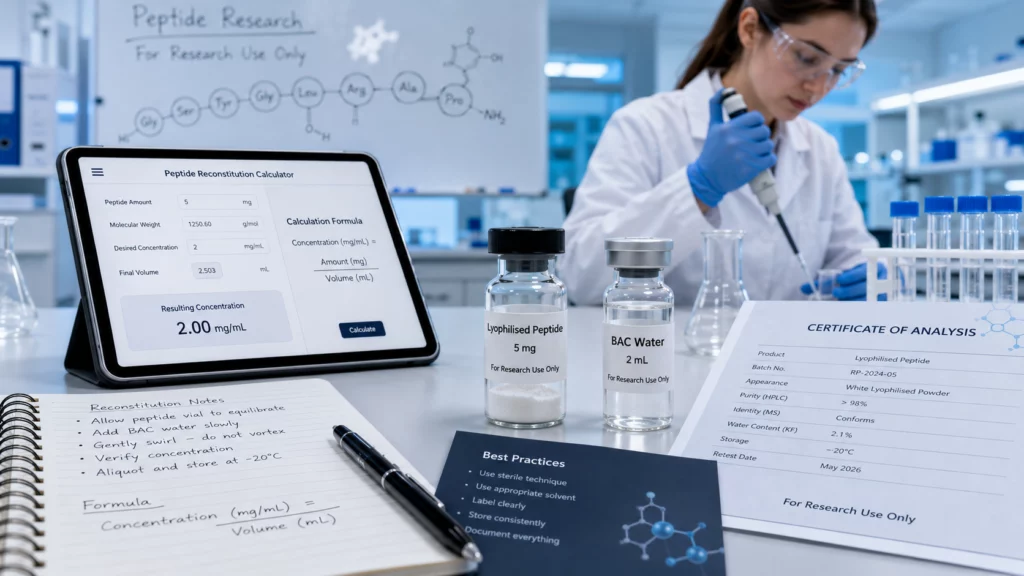
Learning how to reconstitute peptides correctly is important for research consistency. Lyophilised peptides are supplied as dry powder, so researchers need to add a suitable diluent before use in a controlled laboratory workflow.
This guide explains the basic research-only process, how BAC water fits into peptide reconstitution, and why using a calculator helps avoid concentration mistakes.
Research-use only: This article is for laboratory education. It is not medical advice, not dosing guidance, and not a human or veterinary use guide.
What Does Peptide Reconstitution Mean?
Peptide reconstitution means adding a sterile diluent to a lyophilised peptide vial so the dry powder becomes a liquid solution.
The goal is simple: create a known concentration that matches the planned research protocol.
For example, if a vial contains a fixed peptide amount, the volume of liquid added changes the final concentration. That is why researchers should calculate the reconstitution volume before starting.
You can use Polygon’s Peptide Calculator to check planned concentration, vial amount, and research volume before preparing a solution.
What Is BAC Water?
BAC water, also called bacteriostatic water, is sterile water preserved with benzyl alcohol. It is commonly used as a diluent for peptide reconstitution in research settings.
Polygon Peptides offers BAC Water 10ml for peptide reconstitution workflows. The product page lists it as bacteriostatic water containing 0.9% benzyl alcohol.
Before using any diluent, researchers should always check the product page, product label, batch information, and research protocol requirements.
Step 1: Review the Peptide and Protocol
Before opening the vial, confirm the basics:
- Peptide name
- Vial amount
- Batch or lot number
- Certificate of Analysis availability
- Planned concentration
- Research protocol requirements
- Storage instructions
- Suitable diluent
This step prevents simple mistakes. Also, it makes the work easier to document later.
If the peptide has special solubility needs, always follow the product-specific datasheet or supplier guidance.
Step 2: Calculate the Reconstitution Volume
Next, decide the final concentration needed for the research protocol.
This is where many errors happen. Adding too much or too little diluent changes the final concentration.
Use the Polygon Peptide Calculator before starting. It helps researchers plan the relationship between vial amount, liquid volume, and final concentration.
A simple planning rule is:
More diluent = lower concentration
Less diluent = higher concentration
However, the correct volume depends on the peptide amount and research goal. Do not guess this number.
Step 3: Prepare a Clean Research Workspace
Set up a clean, controlled workspace before handling the vial.
Good preparation should include:
- Clean bench space
- Correct peptide vial
- Correct BAC water vial
- Product documentation
- Labels or lab marker
- Reconstitution record sheet
- Suitable sterile lab transfer equipment
- Proper disposal container for lab waste
This is also the right time to check expiry dates, vial condition, and whether packaging looks intact.
Step 4: Let the Lyophilised Vial Reach Room Temperature
Lyophilised peptides are often stored cold before use. If a cold vial is opened too quickly, condensation can enter the vial and affect stability.
Allow the sealed vial to reach room temperature before opening.
This helps reduce moisture exposure and supports better handling.
Step 5: Add BAC Water Slowly
Once the volume has been calculated, add the BAC water slowly using suitable sterile laboratory technique.
Do not blast liquid directly onto the peptide powder. A gentle approach helps avoid foaming and rough handling.
After adding the diluent, let the solution settle.
Avoid vigorous shaking. Instead, gently swirl or roll the vial if needed. The aim is to help the powder dissolve without stressing the peptide solution.
Step 6: Check the Solution Visually
After reconstitution, inspect the vial.
Look for:
- Complete dissolution
- Unexpected particles
- Cloudiness
- Colour changes
- Foam
- Damaged vial seal
- Incorrect label or missing batch information
If the solution looks unusual, do not continue as normal. Review the datasheet, product guidance, and lab procedure before moving forward.
Step 7: Label the Reconstituted Peptide
Every reconstituted vial should be clearly labelled.
Include:
- Peptide name
- Vial strength
- Diluent used
- Volume added
- Final concentration
- Reconstitution date
- Batch or lot number
- Storage condition
- Research-only note
This makes the vial easier to track and reduces confusion during the study.
Step 8: Store the Reconstituted Peptide Correctly
Storage matters because peptides are generally less stable in solution than in dry lyophilised form.
Polygon’s BAC Water page recommends refrigerating reconstituted solutions at 2–8°C, avoiding freeze-thaw cycles, and using within the stated research-use window.
General peptide handling references from Bachem and GenScript also highlight that peptide stability depends on sequence, storage temperature, light exposure, and solution conditions.
Always follow the product-specific instructions first.
Step 9: Record the Reconstitution Details
Documentation is part of good research practice.
Your reconstitution log should include:
- Date and time
- Peptide name
- Batch number
- Starting vial amount
- Diluent type
- Diluent volume
- Final concentration
- Storage temperature
- Researcher initials
- Any unusual observations
This record helps keep the protocol consistent and easier to review later.
Common Peptide Reconstitution Mistakes
Avoid these common mistakes:
- Guessing the volume instead of calculating it
- Skipping the peptide calculator
- Using the wrong diluent
- Opening a cold vial too quickly
- Shaking the vial aggressively
- Failing to label the final solution
- Forgetting the reconstitution date
- Ignoring storage instructions
- Reusing unclear or unlabelled vials
Small handling errors can create big research problems. Therefore, calculation and documentation should happen before reconstitution begins.
BAC Water and Peptide Calculator Links
For easier research planning, use these Polygon Peptides tools and products:
- Peptide Calculator — calculate concentration and reconstitution planning
- BAC Water 10ml — bacteriostatic water for peptide reconstitution
- Shop Research Peptides — browse research-grade peptides
- FAQ — read storage, handling, and research-use guidance
Final Thoughts
Knowing how to reconstitute peptides is not just about adding liquid to a vial. It is about planning concentration, choosing the right diluent, using clean handling methods, storing the final solution correctly, and documenting every step.
For research workflows, start with the Peptide Calculator to plan your concentration. Then use BAC Water 10ml where suitable for the protocol.