Introduction
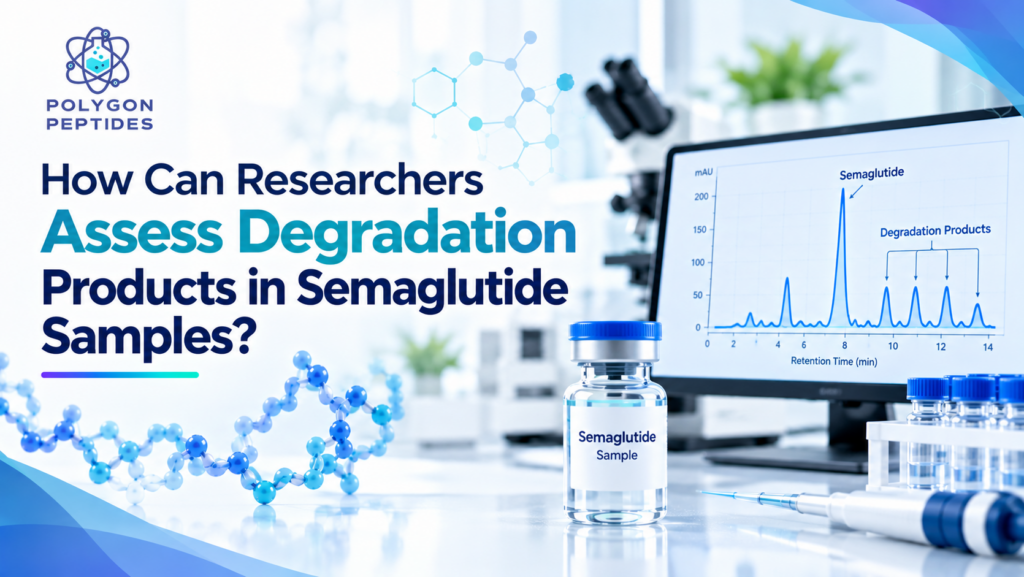
Research semaglutide requires a detailed understanding of how the chemical structure may alter when the substance is stored, processed, and analyzed. The analysis of semaglutide degradation products would provide information about the presence of possible impurities, the integrity of the sample, and the reason behind certain alterations, whether degradation or other reasons. It is necessary to have a proper methodology, reference data, and documentation for such investigations.
The analysis includes chromatography, mass spectrometry, and appropriate control measures. The validation of the procedure will enhance the accuracy of semaglutide stability testing.
Understanding Semaglutide and Its Chemical Characteristics
Why does molecular structure matter?
The answer to the question “Is semaglutide a peptide?” is that semaglutide is a modified peptide molecule. The nature of the amino acid structure and other modifications differentiates semaglutide from a regular peptide.
When looking into semaglutide peptides, researchers should bear in mind that any structural modifications will affect the molecular weight, chromatographic, and other characteristics of the molecule. Degradation of the molecule can occur via oxidation, hydrolysis, and other mechanisms involving molecular groups. The exact process, however, should be found out by experiment rather than by looking at a chromatogram.
Knowledge of the molecular structure gives a starting point for semaglutide impurity profiling.
What Causes Degradation in Semaglutide Samples?
Environmental and chemical influences
Interactions with the container and contamination may further complicate the results of the analysis. The significance of the above factors will depend on the state of the samples and their history.
In 2025, Malgave et al. examined the impact of pH, buffer strength, and temperature on semaglutide stability in terms of the use of chromatography and mass spectrometry. It is clear from this research that the experimental conditions are crucial for evaluating possible degradation pathways.
The oxidation of sensitive functional groups and the breaking of chemical bonds through hydrolysis are some possible reactions. However, researchers need to refrain from claiming oxidation and hydrolysis as confirmed causes of the formation of impurities without additional evidence.
By performing a structured analysis of samples under certain conditions, it is possible to assess whether the changes can be replicated. In this way, it is possible to obtain a more solid foundation for interpreting “semaglutide peptide stability“.
Which Analytical Methods Can Identify Degradation Products?
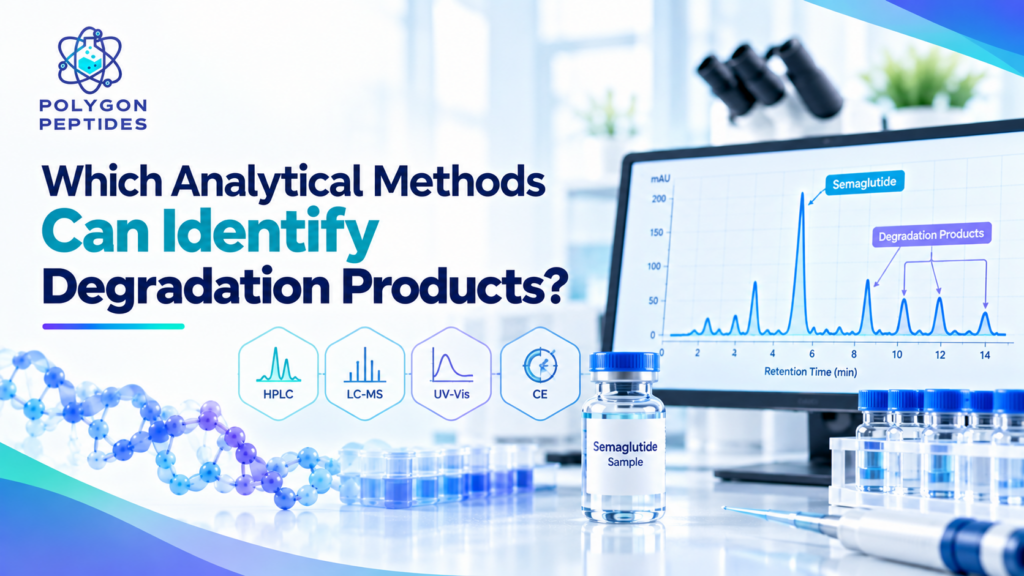
High-performance liquid chromatography
An optimum stability-indicating test method should have the ability to differentiate between the drug substance and its degradants; however, merely the use of HPLC retention times cannot allow for the determination of the structure of an unknown compound.
Ultra-performance liquid chromatography
When used correctly, UPLC could efficiently separate similar compounds from each other due to proper selection of methodology and the column.
The performance of UPLC is dependent on the following parameters: method development, system suitability, and selectivity. Just because of faster analysis time does not necessarily mean that all impurities are going to be detected.
Liquid chromatography–mass spectrometry
LC-MS is an example of mass spectrometry combined with chromatographic separation. In LC-MS, the first step is separation, while the second step involves determination of the mass-to-charge ratio of the analyzed components.
In LC-MS semaglutide analysis, scientists can study unexpected signals using the comparison of detected masses with the plausible modifications of molecules. Tandem mass spectrometry may supply useful data on fragmentations that can reduce the list of potential structures.
High-resolution mass spectrometry may help in even more precise determination of masses. However, a mass match is not enough for identification of all structures. Isomers and other molecules may have the same properties.
Peptide mapping and complementary techniques
Peptide mapping would help structural studies by analyzing fragments obtained using the proper analytical technique. In case of need, spectroscopy could be used for gathering more data on the molecular structure or other changes. Combining various analytical methods increases certainty of semaglutide degradation analysis.
How Can Researchers Collect and Process Samples?
Maintaining sample integrity
Standardized sample preparations are required to ensure reproducibility. Labs need traceability of the samples’ unique identifiers, preparation protocol, proper controls, and documentation of pertinent handling conditions.
10 mg semaglutide peptide, 10 mg semaglutide substance, or 10 mg semaglutide vial refers to the quantity of material. All of these confirm anything about the identification, purity, concentration, and stability of the material.
Interpreting Results and Confirming Degradation
From unexpected peaks to reliable conclusions
For quantitative analysis, investigators need to use calibration as well as show the detection limit. The peak area might not always give the correct quantity of the degradation product if differences in the detector response are taken into account.
A proper investigation will help distinguish between three aspects: the presence of the signal, the determination of the chemical nature, and the confirmation that it is due to degradation.
Documentation, Traceability and UK Research Context
Why research documentation matters
Good documentation links analytical observations with the sample analyzed.
For readers who search for terms related to semaglutide peptide uk, suppliers’ definitions must be separated from independent verification results.
The presence of UK-specific terminology does not guarantee the regulatory status, material suitability, and laboratory quality.
International Conference on Harmonization has well-known guidelines concerning the validation and development of an analytical procedure.
Common Limitations in Semaglutide Degradation Studies
Several issues could be associated with semaglutide impurity profiling. The lack of reference data could also limit identification of the structure of an impurity.
Variation in equipment, column selectivity, sample preparation, and differences in laboratories could influence the reproducibility. In addition, a method developed to quantify the main component of interest would be too unspecific to identify unknown impurities.
The researchers have to determine whether the method meets the requirements of the experiment. Specificity, precision, accuracy, detection ability, and quantification ability are among possible criteria for validation, depending on the nature of the experiment.
Conclusion
Degradation products have to be evaluated on the basis of more than finding another peak in the chromatogram. Semaglutide research that is credible includes correct separation, mass spectrometric or other proof of structure, use of reference materials, and correct handling of samples. Proper methods and uncertainty assessment assist in discerning between degradation and actual compound identity.
FREQUENTLY ASKED QUESTIONS
In most cases, no. HPLC separates different products and detects changes in their chromatograms, but retention times will not give enough information to identify the structures of these products. LC-MS or other methods might have to be used.
The application of reference standards helps in the identification, validation, and measurement of the analyte. The suitability of the reference standard is based on its physical properties and applicability in the test.
Storage conditions and differences in sample processing procedures may affect the identity and detection process of samples. Traceable documentation may help researchers examine these effects.
Validation serves as proof that a particular method has worked satisfactorily for its intended purpose. Validation determines the adequacy of the method for identification or quantification of analytes.