What is bacteriostatic water? It is sterile water that contains 0.9% benzyl alcohol as a preservative, which slows bacterial growth. That one ingredient is what separates it from plain sterile water. This guide covers the composition, what “bacteriostatic” actually means, why the preservative matters for peptide work, and how it differs from sterile water in a laboratory setting.
Quick answer: Bacteriostatic water (BAC water) is sterile water with 0.9% benzyl alcohol added. Sterile water for injection has no preservative. The preservative allows multi-dose vials, but it also makes bacteriostatic water unsuitable for some uses, such as neonates.
Laboratory research context only. This article gives no instructions for human or animal use.
What Is BAC Water Made Of? Bacteriostatic Water Composition
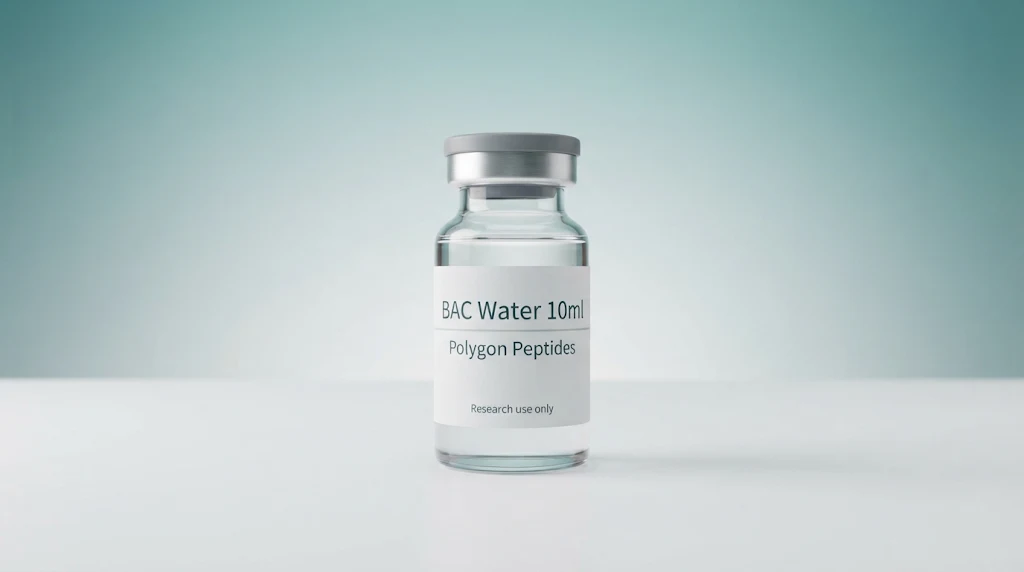
People also ask what is bac water or what is in bac water, and the answer is short: water and a preservative. The DailyMed label describes bacteriostatic water for injection as a sterile, nonpyrogenic preparation containing 0.9% (9 mg/mL) benzyl alcohol, with a pH of 5.7 (range 4.5 to 7.0), intended for diluting or dissolving drugs. The Polygon Peptides 10ml vial also lists 0.9% benzyl alcohol.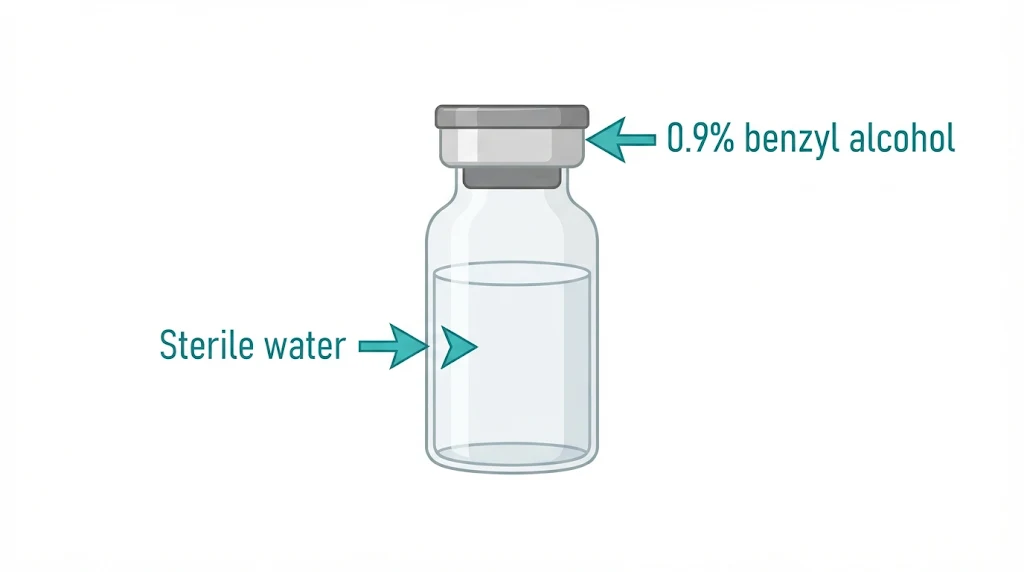
What Does “Bacteriostatic” Mean?
“Bacteriostatic” means an agent inhibits bacterial growth without necessarily killing the bacteria. That differs from “bactericidal”, which describes an agent that kills them. Bacteriostatic water is not a sterilising agent. It is sterile when it leaves the factory, and the preservative helps limit growth if the vial is accessed again later.
Benzyl Alcohol Percentage in Bacteriostatic Water (0.9%)
Benzyl alcohol is an aromatic alcohol used as an antimicrobial preservative. Laboratory work on aromatic alcohols, such as Yano et al. on pentanol and benzyl alcohol, reports that they act on bacterial surface structures. That is the general idea behind adding one to a vial that will be punctured more than once: it helps limit contamination between uses, but at 0.9% it slows growth rather than sterilising the contents.
There is a safety flip side. Benzyl alcohol has been linked to “gasping syndrome” in premature infants, described in a 1982 NEJM report (Gershanik et al.). The DailyMed label carries a neonate warning and states that solutions containing benzyl alcohol must not be used in that group.
Bacteriostatic Water vs Sterile Water
A common question is whether the two are the same. They are not.
| Feature | Bacteriostatic water | Sterile water for injection |
|---|---|---|
| Preservative | 0.9% benzyl alcohol | None |
| Container | Multi-dose vial | Single-dose container |
| Typical limit | Not for neonates | Use once, discard remainder |
The DailyMed label for Sterile Water for Injection describes it as a sterile, nonpyrogenic preparation containing no bacteriostat, antimicrobial agent or added buffer, supplied in single-dose containers to dilute or dissolve drugs.
Bacteriostatic Water pH: Is It a Buffer?
No, and this is often misunderstood. The label gives a pH of 5.7 with an allowed range of 4.5 to 7.0, which is wide, and it does not describe the product as buffered. For a peptide, that means the diluent does not hold a stable pH on its own. If pH matters to a research design, it needs to be controlled separately. This is one reason bacteriostatic water is not the right choice for every compound.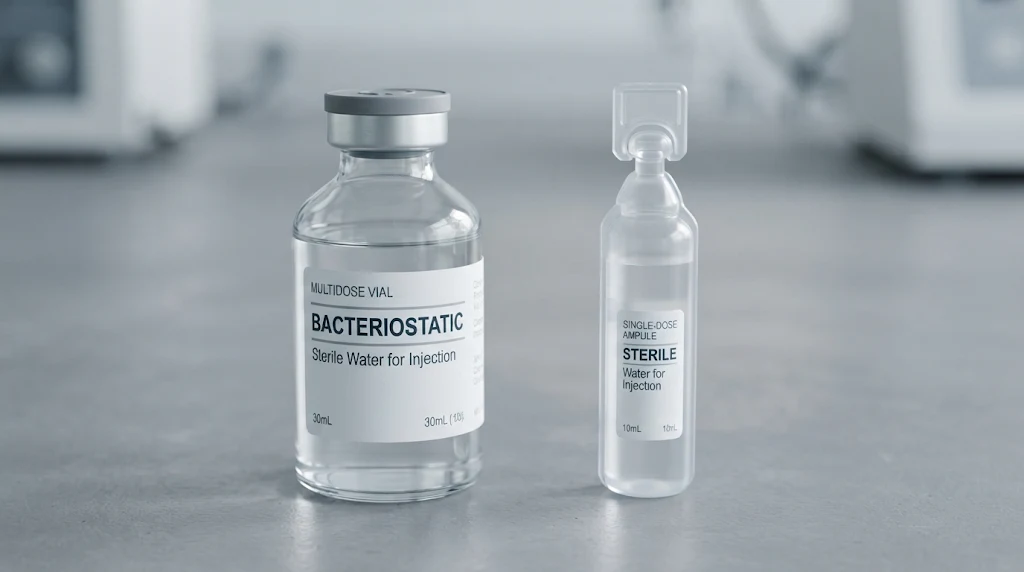
Using Bacteriostatic Water With Peptides in Research
Bacteriostatic water for peptides is chosen in research settings because the preservative supports repeated access to a stock vial. The trade-off is compatibility. A review of antimicrobial preservatives for protein and peptide formulations notes that certain preservatives have been reported to increase protein and peptide particle formation, so the preservative has to suit the compound as well as do its preserving job. A systematic study of a model peptide with benzyl alcohol, phenol and m-cresol (Heljo et al. 2015) looked at the same question. Whether it suits a particular experiment depends on the protocol.
For the handling basics, see our guides on reconstituting peptides and peptide storage. The peptide calculator covers concentration arithmetic.
Storage and Discard Dates
The DailyMed label states to store at 20 to 25°C (68 to 77°F) and does not specify a discard-after-opening period, so always follow your supplier’s labelling. The BAC Water 10ml product page says to store unopened vials at room temperature away from direct light, and after opening to refrigerate at 2 to 8°C and discard 28 days after first use.
Checking a Vial Before Laboratory Use
Whatever the supplier, a few visual checks are standard practice:
- Do not use a vial with a cracked body or a damaged seal.
- Do not use a vial that looks cloudy or contains visible particles.
- Do not use a vial past its expiry date.
- Treat any vial of uncertain history as unsuitable and replace it.
Water that has gone bad is a contamination problem, so when in doubt, discard.
Label Cautions Worth Knowing
The label also notes that bacteriostatic water given intravenously without a solute may result in hemolysis. This article gives no guidance on that kind of use. It is mentioned because it shows why bacteriostatic water is a diluent and not a standalone fluid.
What Bacteriostatic Water Is Not
- It is not a drug and has no activity on its own.
- It is not interchangeable with saline.
- It is not a buffer.
- It is not a substitute for single-dose sterile water where a preservative is contraindicated.
Frequently Asked Questions
What is bacteriostatic water?
Sterile water containing 0.9% benzyl alcohol as a preservative.
Is bacteriostatic water the same as sterile water?
No. Sterile water has no preservative and is supplied in single-dose containers. Bacteriostatic water contains benzyl alcohol and is supplied in multi-dose vials.
What does bacteriostatic mean?
It means the agent inhibits bacterial growth rather than necessarily killing bacteria.
Is bacteriostatic water sterile?
It is supplied sterile. The preservative helps limit growth after the vial has been opened, but it does not replace careful handling.
Does bacteriostatic water expire?
Yes. Check the expiry date on the vial and follow the supplier’s discard guidance after opening.
Why is benzyl alcohol added?
To inhibit bacterial growth in vials that are accessed more than once.
Is bacteriostatic water a buffer?
No. The label gives a pH of 5.7 with a range of 4.5 to 7.0 and does not describe the product as buffered.
Can bacteriostatic water be used for neonates?
No. The label warns that solutions containing benzyl alcohol must not be used in neonates.
Is bacteriostatic water the same as saline?
No. Saline contains sodium chloride. Bacteriostatic water contains benzyl alcohol.
What is the pH of bacteriostatic water?
The DailyMed label for bacteriostatic water for injection gives a pH of 5.7, with an allowed range of 4.5 to 7.0. It is not described as a buffered solution.
What percentage of benzyl alcohol is in bacteriostatic water?
Bacteriostatic water contains 0.9% benzyl alcohol, which is 9 mg/mL. This preservative slows bacterial growth in a multi-dose vial.
 Conclusion
So, what is bacteriostatic water? It is sterile water plus a preservative. That preservative is what allows multi-dose vials, and also what rules it out in certain situations. It is not a buffer, it does not kill bacteria outright, and its storage and discard guidance should always come from the supplier’s label. Knowing these differences from sterile water helps you choose the right diluent for laboratory work.
Educational content for laboratory research only. Not medical advice.
References
- DailyMed. Bacteriostatic Water for Injection, USP label (set ID ccadcf46-6a6f-436b-9bbc-17e2983a335f).
- DailyMed. Sterile Water for Injection, USP label (set ID 48d75a7c-8329-48a8-bea0-a8c144ddf637).
- Gershanik J, et al. The gasping syndrome and benzyl alcohol poisoning. N Engl J Med. 1982;307(22):1384-1388. PMID 7133084
- Yano T, et al. Pentanol and Benzyl Alcohol Attack Bacterial Surface Structures Differently. 2015. PMC4702632
- Stroppel L, et al. Antimicrobial Preservatives for Protein and Peptide Formulations: An Overview. 2023. PMC10217790
- Heljo P, et al. Interactions Between Peptide and Preservatives: Effects on Peptide Self-Interactions and Antimicrobial Efficiency In Aqueous Multi-Dose Formulations. 2015. PMID 25893328