If you have searched wolverine stack peptide, the short answer is that it is an informal name for pairing two research peptides, BPC-157 and TB-500. No single compound sits behind the name, and there is no fixed formulation. Most of what has been published about the two comes from cell and animal studies, and very little of it tests them together. This guide explains what each peptide is, how a blend differs from two separate vials, what the research does and does not show, and how researchers handle them in the laboratory.
Quick answer: The Wolverine stack is a nickname for BPC-157 and TB-500 offered together, in one vial or two. It is not a registered formulation. Published work is mostly cell and animal research, no human dose is established, and it is not an approved drug.
Everything below is written for laboratory researchers. Polygon Peptides supplies these compounds for research use only, and nothing on this page is medical advice or a suggestion to use any peptide on people or animals.
What Is the Wolverine Stack Peptide?
The name was lifted from a comic-book character and works as retail shorthand, not as a scientific designation. Across the peptide market, wolverine stack peptides means BPC-157 and TB-500 supplied as a pair. Here “stack” just means a set of more than one peptide, and the wolverine peptide stack is one of the most widely recognised sets.
With no agreed definition, the term only tells you which two compounds are involved. Amounts, packaging (one vial or two) and the exact form of TB-500 are left open, so two suppliers using the same name may sell different things.
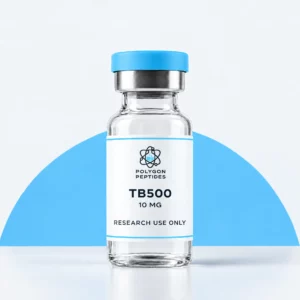
Polygon Peptides lists Wolverine Blend 20mg as a single lyophilised vial containing 10mg BPC-157 and 10mg TB-500. Each compound can also be ordered on its own.
BPC-157 and TB-500: The Two Peptides Explained
| Compound | Size | Origin | Main published research context |
|---|---|---|---|
| BPC-157 | 15 amino acids | Synthetic sequence based on a protein found in gastric juice | Tissue-repair and angiogenesis models in animals |
| TB-500 | 7 amino acids, N-acetylated (Ac-LKKTETQ) as characterised in analytical papers | Synthetic version of residues 17 to 23 of thymosin beta-4 | Anti-doping chemistry, wound-healing models |
| Thymosin beta-4 | 43 amino acids | Naturally occurring protein | Actin-binding and cell-migration research |
BPC-157
BPC-157 stands for body protection compound 157. The peptide is a short chain of 15 amino acids whose order is taken from part of a larger protein in gastric juice. According to PubChem, its formula is C62H98N16O22 and its molecular weight is about 1,419.5 g/mol. For its published literature in more depth, see our BPC-157 research overview.
TB-500 and Why the Name Is Confusing
In the analytical literature, TB-500 refers to a synthetic, N-acetylated seven-residue peptide, LKKTETQ, matching residues 17 to 23 of thymosin beta-4. Two doping-control papers identified exactly this sequence in TB-500 products (Esposito et al., 2012; Ho et al., 2012). The complete thymosin beta-4 protein is much longer, at 43 amino acids.
Product listings frequently treat the two names as one, so a vial marked TB-500 could contain either the short fragment or the full protein. The fragment weighs about 889.0 g/mol (PubChem), far less than the whole protein, which makes the supplier’s documentation the place to confirm what is actually supplied. Results on the full protein cannot be assumed to hold for the fragment. The two peptides are compared directly in our BPC-157 vs TB-500 guide.
Wolverine Stack Blend vs Two Separate Vials
The same two compounds can be supplied in two formats, and the choice affects how a study is designed.
| Factor | One-vial blend | Two separate vials |
|---|---|---|
| Ratio between BPC-157 and TB-500 | Set in advance by the supplier | Decided by the researcher |
| Single-compound control groups | Not possible from the blend alone | Straightforward |
| Reconstitution | One vial to prepare | Two vials to prepare |
| Batch records | One record covering two compounds | One record per compound |
| Flexibility | Lower | Higher |
A blend cannot show which component produced an observation, so work that compares the compounds needs single-compound arms alongside it, and that is simpler with separate vials. For this reason, BPC-157 10mg and TB-500 10mg can be bought individually as well. Whichever format is used, the peptide calculator handles the concentration arithmetic from vial quantity and diluent volume.
If you are comparing blends, the GLOW blend adds GHK-Cu to the BPC-157 and TB-500 pairing, and our guide explains how the three components relate.
What Published Research Shows, and Where It Stops
The bulk of the published evidence on these two peptides is preclinical. It comes from cell cultures and animal models, and results like these generate hypotheses rather than answer questions about people.
BPC-157 studies
For an HSS Journal systematic review, Vasireddi et al. (2025) screened 544 articles and kept 36. Of the 36, 35 were preclinical and the single remaining study was clinical. The preclinical findings they summarised relate to growth hormone receptor expression and to cell-growth and angiogenesis pathways. A cell study gives an example of the mechanistic end: BPC-157 raised growth hormone receptor expression in rat tendon fibroblasts (Chang et al., 2014). That is one cell type from one species under defined culture conditions.
A 2025 narrative review counted only three small human pilot studies and concluded that rigorous large-scale trials are lacking (McGuire et al., 2025).
TB-500 studies
A large part of the TB-500 literature is analytical chemistry rather than biology. Esposito et al. (2012) identified Ac-LKKTETQ in a TB-500 product and proposed a way to detect it, while Ho et al. (2012) described a method for finding it in horse urine and plasma. These papers establish what the material is. Whether it has any biological effect is not something they examined.
The two together
The most direct test of the pair among the sources reviewed is a 2026 study of Achilles tendon repair in rats (Biçer et al., 2026). Thirty-two animals were split into four groups of eight: control, BPC-157, TB-500 and the two combined. The authors examined strength and tissue structure after four weeks. Significant differences were reported for the TB-500 group on several measures and for the combined group on one histology score.
This is one small rodent study. Its results cannot be carried over to other models, and they say nothing about people.
What the research does not show
There is no established human dose, no human safety profile and no proven benefit for any condition. A 2026 scoping review of six emerging peptides, including BPC-157 and TB-500, found that 67% of the publications it identified used preclinical animal models, and that the human studies were limited and mostly lacked rigorous design (Tewari et al., 2026). Doses used in animals cannot be converted into human amounts. Any page claiming that the Wolverine stack “heals tendons” goes beyond the published data.
Is the Wolverine Stack Approved or Allowed?
It is not an approved medicine. The 2025 systematic review notes that BPC-157 lacks US FDA approval (Vasireddi et al., 2025). In July 2026 the US FDA’s Pharmacy Compounding Advisory Committee voted 8 to 6, with one abstention, to recommend adding both BPC-157 and TB-500 to the 503A bulk drug substances list, even though FDA staff had recommended against adding them. Legal summaries from DLA Piper note that committee votes are non-binding and that formal rulemaking is still required. That is a US compounding question. It says nothing about whether either peptide works or is safe.
The World Anti-Doping Agency lists BPC-157, and thymosin beta-4 and its derivatives such as TB-500, under its S0 category of non-approved substances. Polygon Peptides supplies these compounds for laboratory research use only, not for human or animal consumption.
Wolverine Stack Peptide Safety: What Is and Is Not Known
Controlled human safety data are very limited. The narrative review above found no adverse effects in its three small pilot studies, but it described them as pilots and called for larger trials (McGuire et al., 2025). A 2026 review of approved and unapproved peptides in sports medicine states that rigorous human safety data are scarce for this group of compounds (Mendias and Awan, 2026). Cell and animal studies cannot establish safety in people.
In the laboratory, these peptides are handled like any research chemical: kept labelled, stored as the supplier directs, used only by trained staff and never on people or animals.
Is There a Standard Wolverine Stack Dosage?
No. No standard exists, because there are no completed human trials, and quantities used in cell or animal experiments cannot be converted into a human amount. For that reason this guide does not list doses, schedules or administration routes, and Polygon Peptides does not provide them.
Storage and Handling of Lyophilised Peptides
Research peptides are normally supplied as lyophilised (freeze-dried) powder, which is more stable than a solution. Follow the storage conditions given in the supplier’s documentation for the unopened vial, and keep it dry and out of direct light.
Once reconstituted, peptide solutions are generally refrigerated, protected from light and not repeatedly frozen and thawed, because freeze-thaw cycles can degrade peptides. Our guides cover the details: how to reconstitute peptides step by step and the peptide storage guide for freeze-dried and reconstituted peptides. BAC Water 10ml is the diluent many laboratories use for this step.
If you are sourcing material for laboratory work, Wolverine Blend 20mg is supplied as lyophilised powder for research use only.
Frequently Asked Questions
What is the Wolverine stack peptide in simple terms?
It is a nickname for BPC-157 and TB-500 offered together, as one blended vial or as two vials. It is not an approved medicine, and published research is mostly in cells and animals.
What is in the Wolverine stack?
BPC-157, a 15-amino-acid peptide, and TB-500, usually a short fragment of thymosin beta-4. The name does not fix the amounts or the form, so check the supplier’s documentation.
Is the Wolverine stack the same as BPC-157?
No. BPC-157 is one of the two components. The stack adds TB-500, which is chemically unrelated.
Is TB-500 the same as thymosin beta-4?
Not necessarily. In analytical papers TB-500 is a seven-amino-acid fragment of the 43-amino-acid protein, but sellers sometimes use the names interchangeably, so check which molecule is supplied.
Is the Wolverine stack safe?
Human safety has not been established. Published work is mostly preclinical, so it is for laboratory research only.
Is the Wolverine stack FDA approved?
No. In July 2026 an FDA advisory committee voted to recommend adding BPC-157 and TB-500 to a US compounding list, but the vote is non-binding and formal rulemaking is still required.
Does the Wolverine stack work?
That depends on the model. Animal and cell studies report effects in tendon-repair models, but they do not show effects in people, and only one small rat study has tested the pair together.
Conclusion
So, what is the wolverine stack peptide? It is a nickname for BPC-157 and TB-500 sold together, studied mostly as separate compounds in cell and animal models and together in very few. The evidence is real but early, and it stops well short of human data. The best approach for researchers is to go back to the primary papers, check which TB-500 molecule a supplier means, treat claims about doses or benefits with caution, and use the peptide calculator and our storage guides for the practical side of the work.
For laboratory research use only. Not for human or animal consumption. Nothing on this page is medical advice.
References
- Vasireddi N, et al. Emerging Use of BPC-157 in Orthopaedic Sports Medicine: A Systematic Review. HSS J. 2025;21(4):485-495. PMID 40756949
- McGuire FP, et al. Regeneration or Risk? A Narrative Review of BPC-157 for Musculoskeletal Healing. Curr Rev Musculoskelet Med. 2025;18(12):611-619. PMID 40789979
- Chang CH, et al. Pentadecapeptide BPC 157 enhances the growth hormone receptor expression in tendon fibroblasts. Molecules. 2014;19(11):19066-19077. PMID 25415472
- Esposito S, et al. Synthesis and characterization of the N-terminal acetylated 17-23 fragment of thymosin beta 4 identified in TB-500. Drug Test Anal. 2012;4(9):733-738. PMID 22962027
- Ho EN, et al. Doping control analysis of TB-500 in equine urine and plasma by LC-MS. J Chromatogr A. 2012;1265:57-69. PMID 23084823
- Biçer O, et al. Effects of BPC-157 and TB-500 on Achilles tendon healing in rats. Jt Dis Relat Surg. 2026;37(3):822-837. PMID 42542926
- Tewari K, et al. Peptide Supplements and Their Therapeutic Applications in Sports Medicine. Am J Sports Med. 2026. PMID 42578445
- Mendias CL, Awan TM. Safety and Efficacy of Approved and Unapproved Peptide Therapies for Musculoskeletal Injuries and Athletic Performance. Sports Med. 2026;56(8):1921-1935. PMID 41966639
- PubChem. BPC-157, CID 9941957; TB-500 fragment, CID 62707662.
- World Anti-Doping Agency. The Prohibited List.
- DLA Piper. Compounding at the crossroads: FDA AdComm recommends adding six peptides to the 503A Bulk Drug Substances List. 31 July 2026.
- US FDA. July 23-24, 2026 Meeting of the Pharmacy Compounding Advisory Committee.